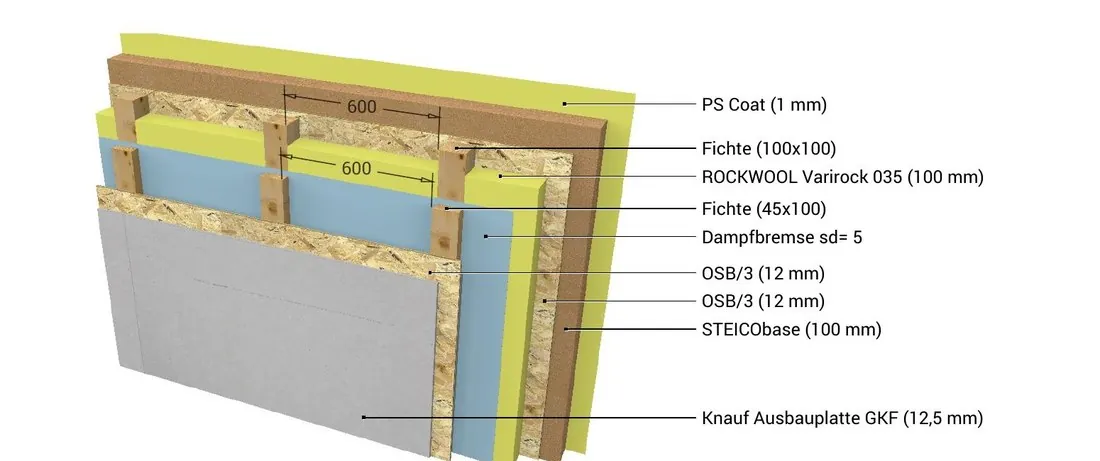
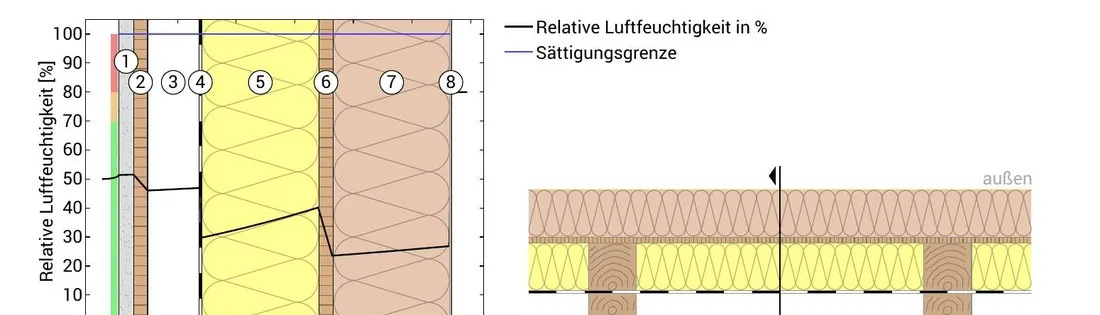
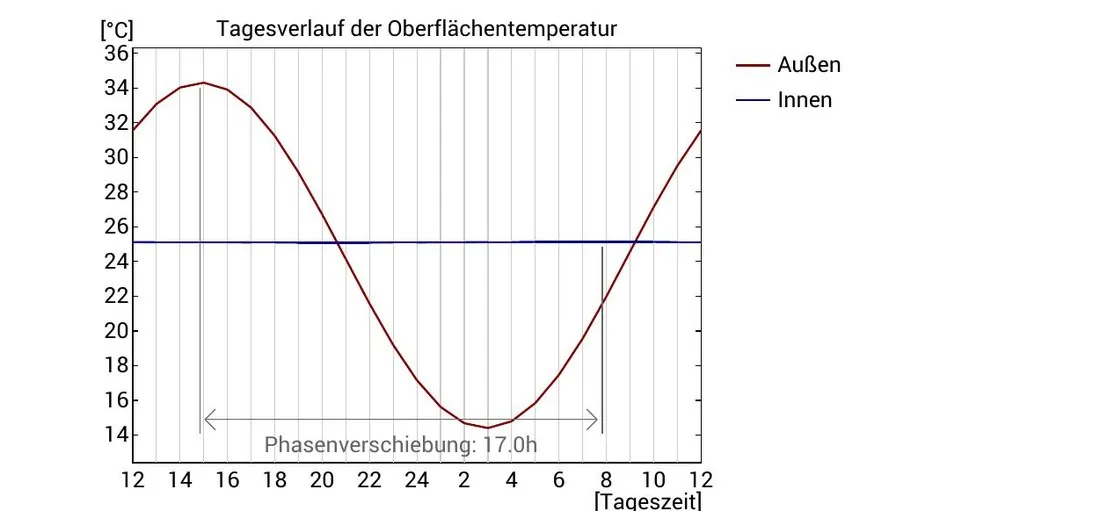
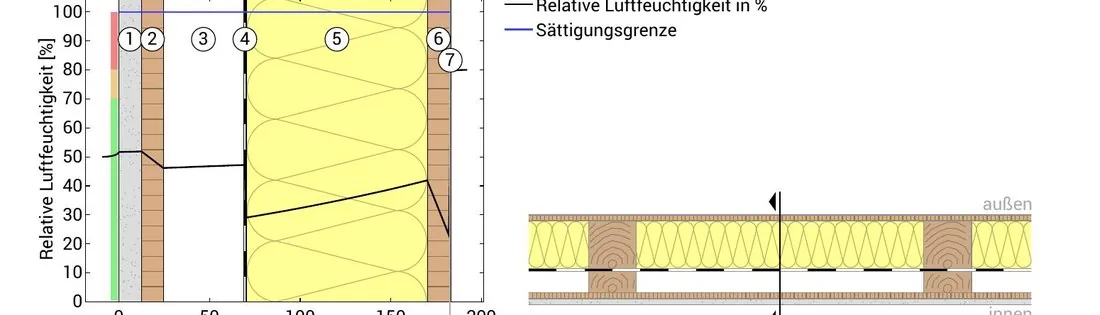
Ubakus building component calculation (U-value, moisture and heat protection per DIN EN ISO 6946/DIN 4108-3) for a timber frame wall in a converted attic: from inside to outside, plasterboard (12.5 mm), OSB/3 (12 mm), installation layer with ROCKWOOL Varirock 035 insulation (100 mm) between studs, OSB/3 (12 mm), STEICObase wood fiber board (100 mm), PS Coat on the exterior (1 mm).
Layer structure of the timber frame wall (Ubakus component illustration)Moisture protection: relative humidity within the component cross-sectionHeat protection: daily course of surface temperature
U-value
0,08 W/(m²K)
Drying reserve
837 g/(m²a)
Condensation
keines
Amplitude damping
> 100
sd-value, overall component
11,71 m
PS Coat: thermal resistance R (at 1 mm)
8,333 m²K/W
PS Coat: sd-value (at 1 mm)
0,22 m
Result: The U-value of 0.08 W/(m²K) is well below the KfW-40 threshold (0.15 W/(m²K)); under the assumed boundary conditions per DIN 4108-3, no condensation occurs, and the drying reserve is far above the minimum value required by DIN 68800-2. Summer heat protection is very good, with an amplitude damping > 100.
Generic calculation example (Ubakus software). The values assumed for PS Coat (R = 8.333 m²K/W, sd = 0.22 m at 1 mm layer thickness) match exactly with the manufacturer's own derivation (λ = 0.000120 W/mK, μ = 220 – see manufacturer information "Calculated system value for water vapor permeability") and independently confirm it.
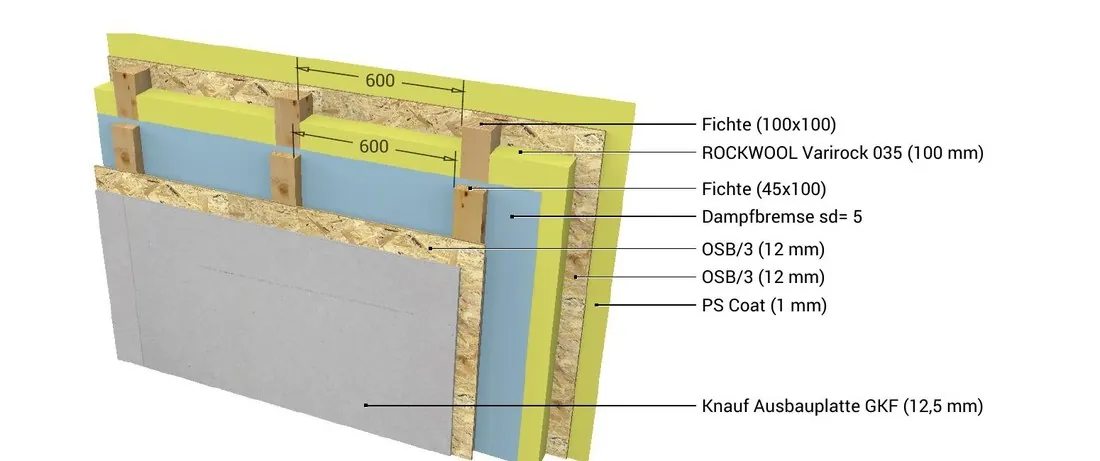
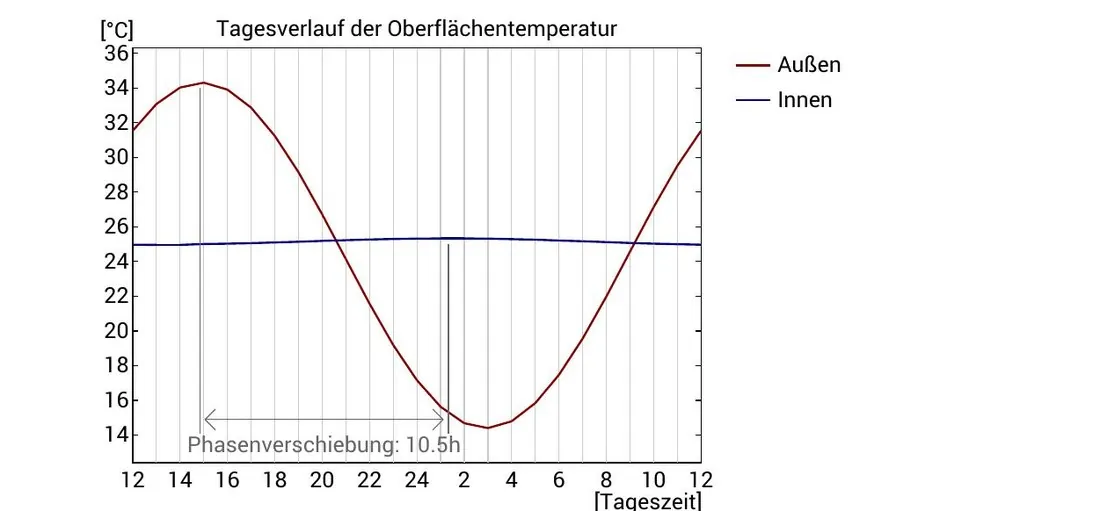
Ubakus building component calculation (U-value, moisture and heat protection per DIN EN ISO 6946/DIN 4108-3) for a timber frame wall in a converted attic, variant without an exterior wood fiber board: from inside to outside, plasterboard (12.5 mm), OSB/3 (12 mm), installation layer with ROCKWOOL Varirock 035 insulation (100 mm) between studs, OSB/3 (12 mm), PS Coat directly on the exterior (1 mm).
Layer structure of the timber frame wall without wood fiber board (Ubakus component illustration)Moisture protection: relative humidity within the component cross-sectionHeat protection: daily course of surface temperature
U-value
0,09 W/(m²K)
Drying reserve
855 g/(m²a)
Condensation
keines
Amplitude damping
56,5
Phase shift
10,5 h
sd-value, overall component
11,21 m
PS Coat: thermal resistance R (at 1 mm)
8,333 m²K/W
PS Coat: sd-value (at 1 mm)
0,22 m
Result: The U-value of 0.09 W/(m²K) remains well below the KfW-40 threshold (0.15 W/(m²K)); under the assumed boundary conditions per DIN 4108-3, no condensation occurs, and the drying reserve is far above the minimum value required by DIN 68800-2. Without the additional wood fiber board, summer heat protection is noticeably lower (amplitude damping 56.5 instead of > 100 with the wood fiber board), but remains in the good range.
Generic calculation example (Ubakus software). The values assumed for PS Coat (R = 8.333 m²K/W, sd = 0.22 m at 1 mm layer thickness) match exactly with the manufacturer's own derivation (λ = 0.000120 W/mK, μ = 220 – see manufacturer information "Calculated system value for water vapor permeability") and independently confirm it. Direct comparison to the variant with a wood fiber board: see the calculation example "Timber frame wall with PS Coat exterior".
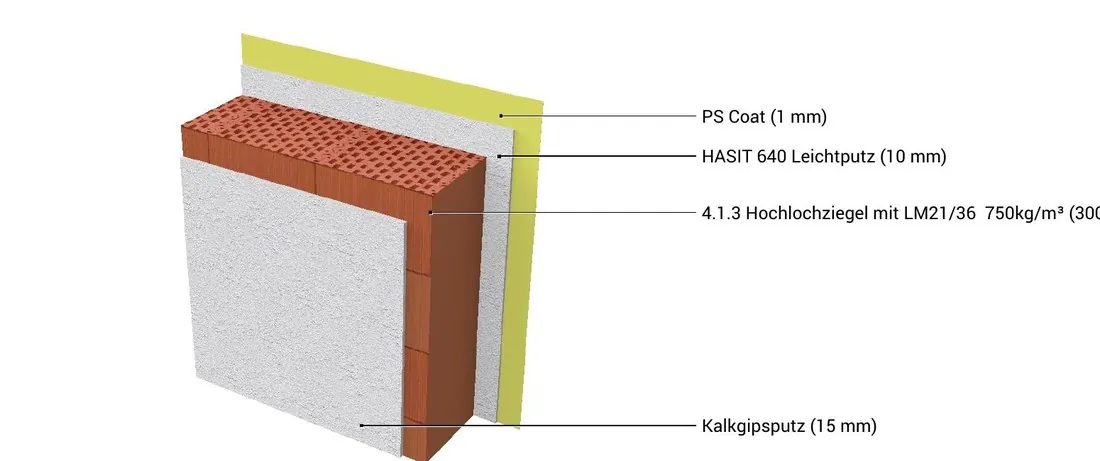
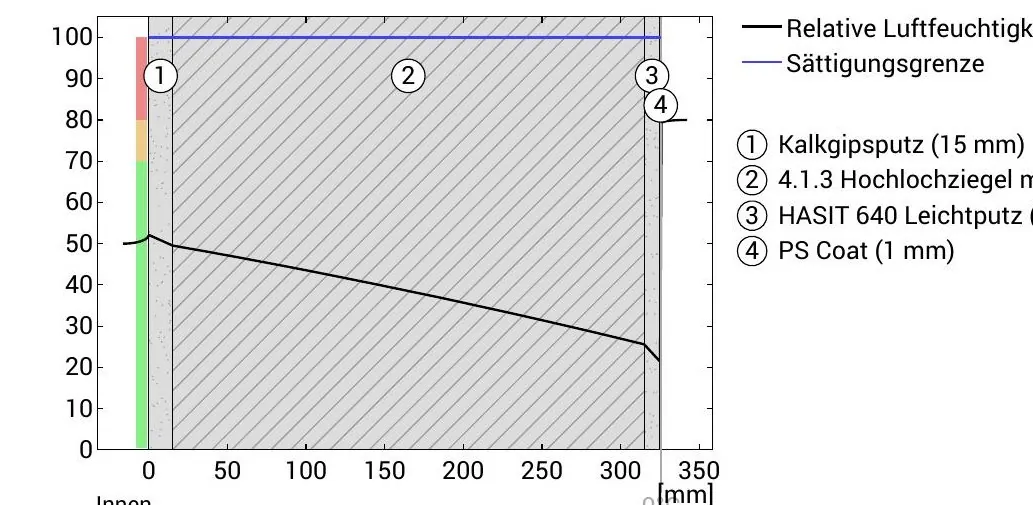
Ubakus building component calculation (U-value, moisture and heat protection per DIN EN ISO 6946/DIN 4108-3) for a solid brick exterior wall: from inside to outside, lime-gypsum plaster (15 mm), hollow brick with lightweight mortar LM21/36, 750 kg/m³ (300 mm), HASIT 640 lightweight render (10 mm), PS Coat on the exterior (1 mm).
Layer structure of the solid brick wall (Ubakus component illustration)Moisture protection: relative humidity within the component cross-sectionHeat protection: daily course of surface temperature
U-value
0,11 W/(m²K)
Drying reserve
5434 g/(m²a)
Condensation
keines
Amplitude damping
> 100
sd-value, overall component
2,07 m
PS Coat: thermal resistance R (at 1 mm)
8,333 m²K/W
PS Coat: sd-value (at 1 mm)
0,22 m
Result: The U-value of 0.11 W/(m²K) is well below the KfW-55 threshold (0.2 W/(m²K)); under the assumed boundary conditions per DIN 4108-3, no condensation occurs, and the drying reserve at 5434 g/(m²a) is very high. Summer heat protection is very good, with an amplitude damping > 100 thanks to the high thermal storage mass of the brick wall.
Generic calculation example (Ubakus software). Unlike the timber frame wall calculation examples, this is a solid brick construction – demonstrating the use of PS Coat on a mineral render substrate as well. The values assumed for PS Coat (R = 8.333 m²K/W, sd = 0.22 m at 1 mm layer thickness) again match exactly with the manufacturer's own derivation (λ = 0.000120 W/mK, μ = 220 – see manufacturer information "Calculated system value for water vapor permeability"), confirming it independently for a third time.
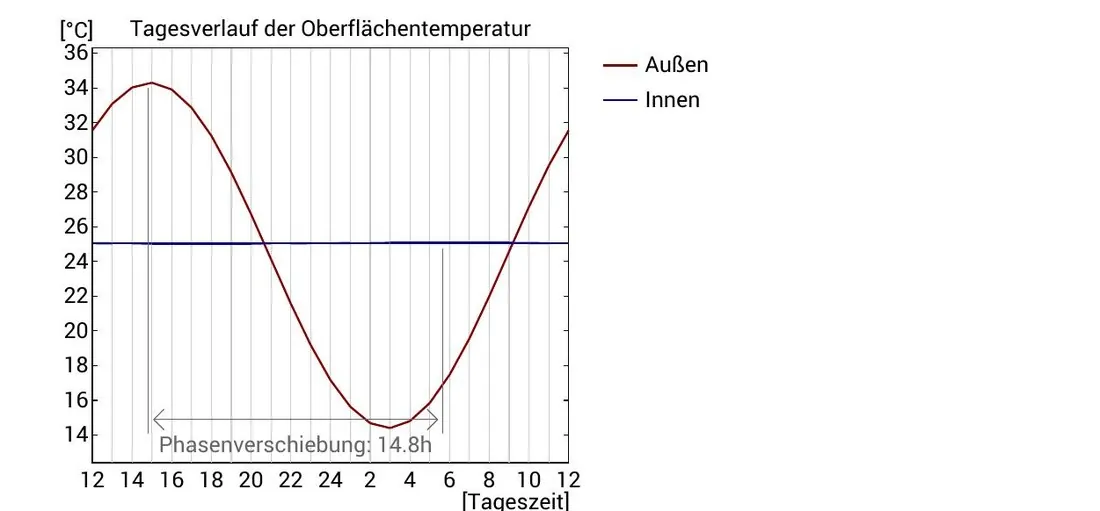
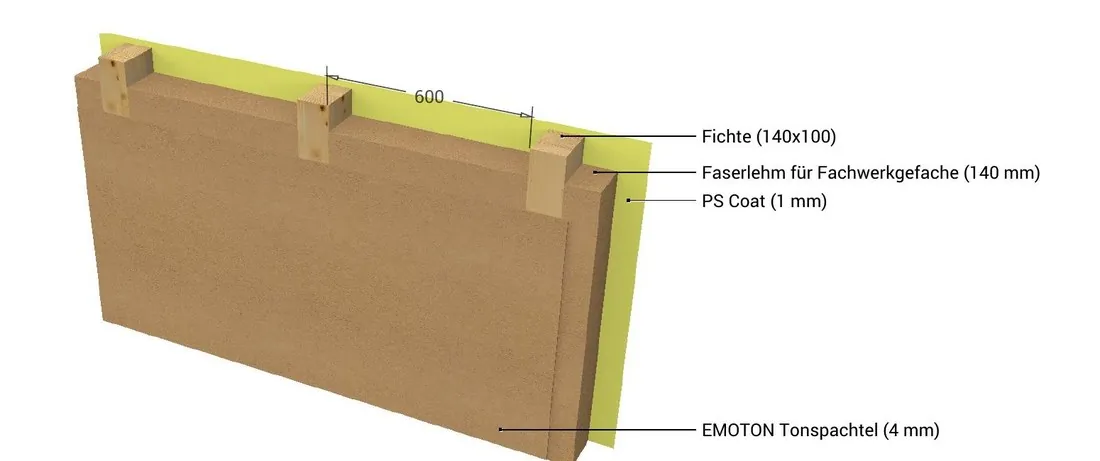
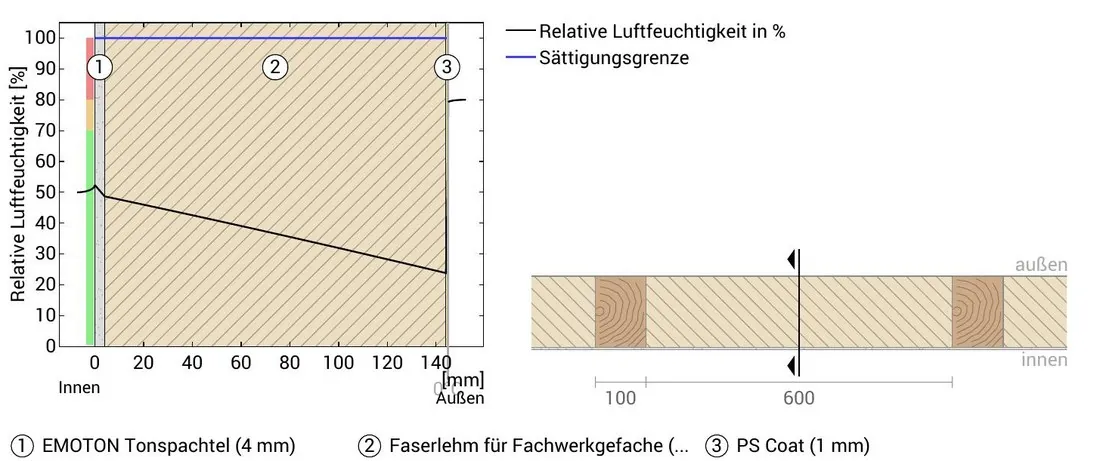
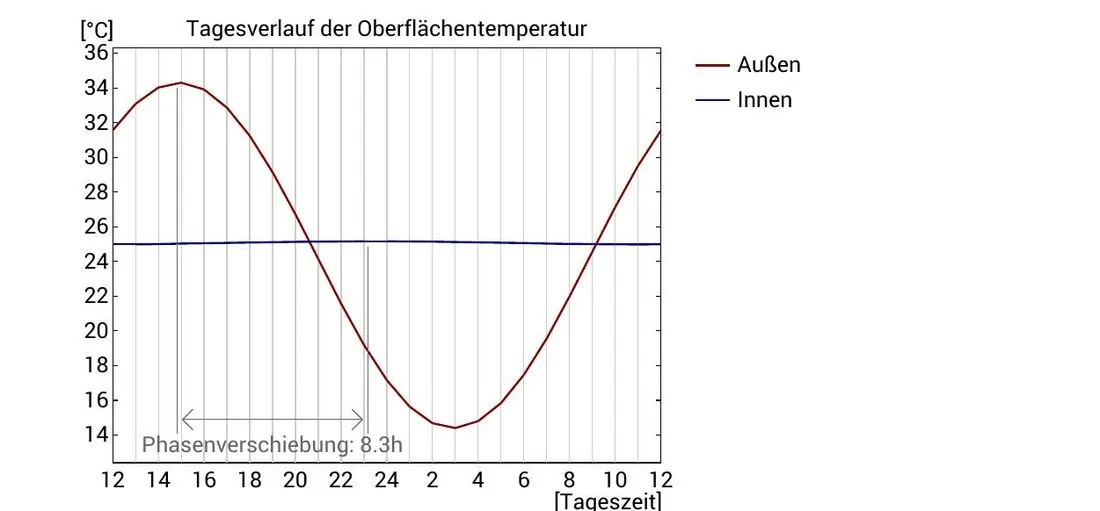
Ubakus building component calculation (U-value, moisture and heat protection per DIN EN ISO 6946/DIN 4108-3) for a half-timbered wall: from inside to outside, EMOTON clay filler (4 mm), fiber clay for half-timber infill panels, 1200 kg/m³ (140 mm, infill between spruce timber-frame beams 140×100), PS Coat on the exterior (1 mm).
Layer structure of the half-timbered wall (Ubakus component illustration)Moisture protection: relative humidity within the component cross-sectionHeat protection: daily course of surface temperature
U-value
0,11 W/(m²K)
Drying reserve
11644 g/(m²a)
Condensation
keines
Amplitude damping
> 100
sd-value, overall component
1,12 m
PS Coat: thermal resistance R (at 1 mm)
8,333 m²K/W
PS Coat: sd-value (at 1 mm)
0,22 m
Result: The U-value of 0.11 W/(m²K) is well below the maximum value for GEG existing-building renovation (0.24 W/(m²K)); under the assumed boundary conditions per DIN 4108-3, no condensation occurs, and the drying reserve at 11644 g/(m²a) is exceptionally high (vapor-open clay infill construction). Summer heat protection is very good, with an amplitude damping > 100.
Generic calculation example (Ubakus software). Third construction type alongside timber frame and solid masonry construction – demonstrating the use of PS Coat on diffusion-open clay half-timber infill. The values assumed for PS Coat (R = 8.333 m²K/W, sd = 0.22 m at 1 mm layer thickness) match exactly with the manufacturer's own derivation for a fourth time (λ = 0.000120 W/mK, μ = 220 – see manufacturer information "Calculated system value for water vapor permeability").
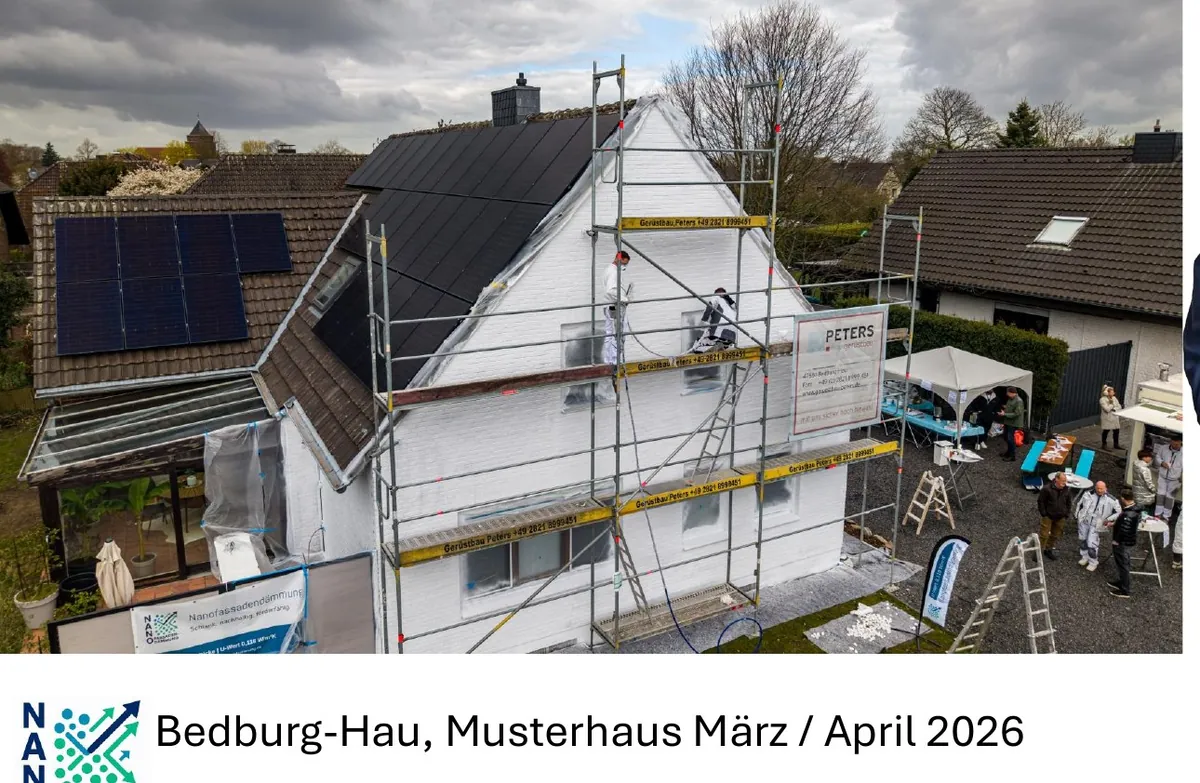
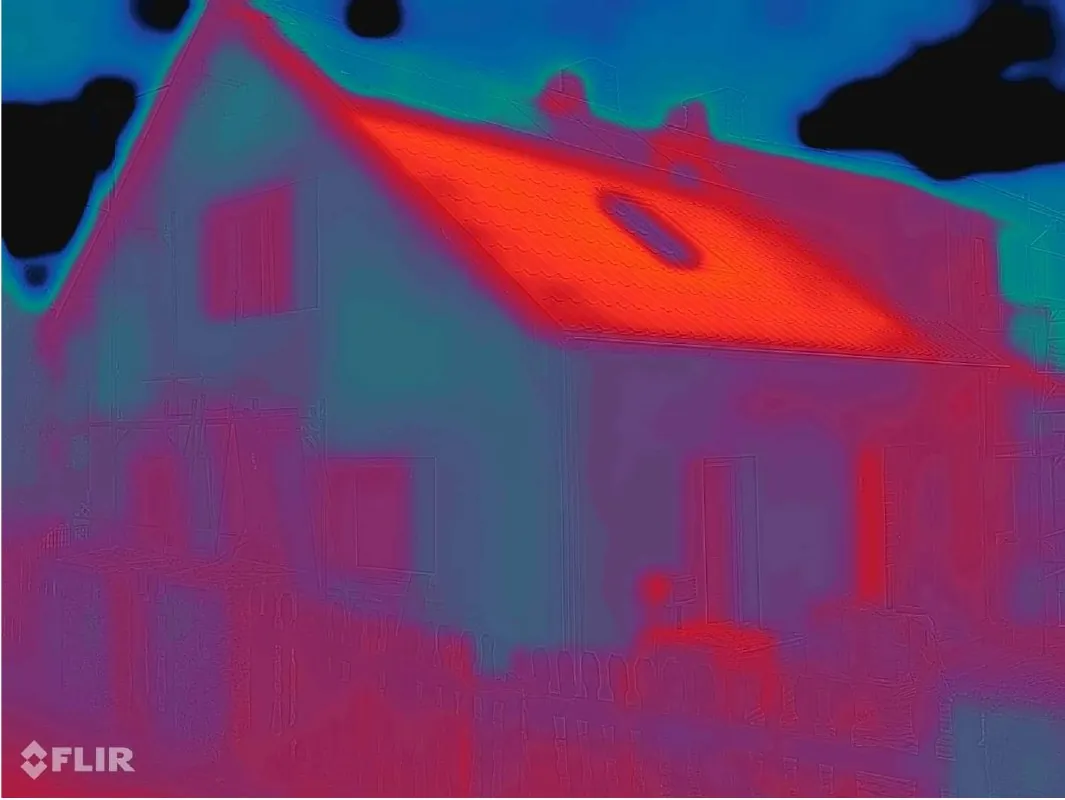
Thermal imaging measurement on a thermo-reflectively coated residential building
Musterhaus Bedburg-Hau, Mittelweg 41
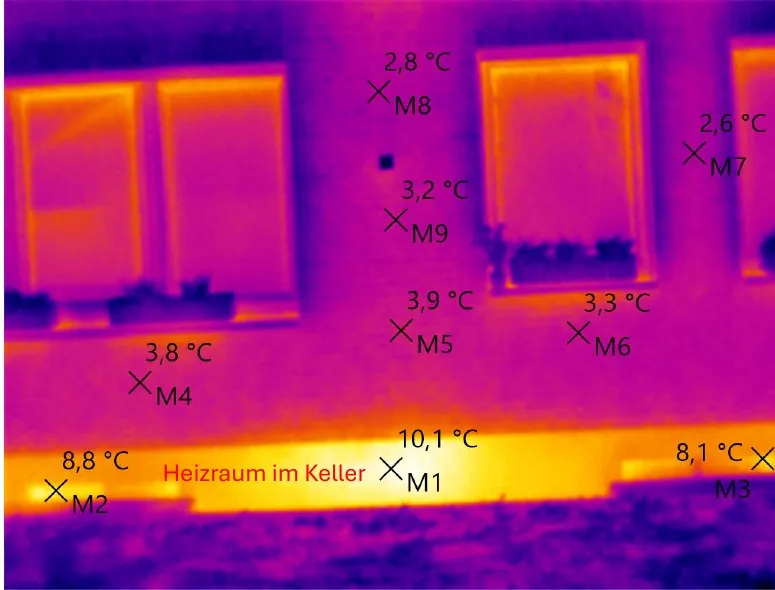
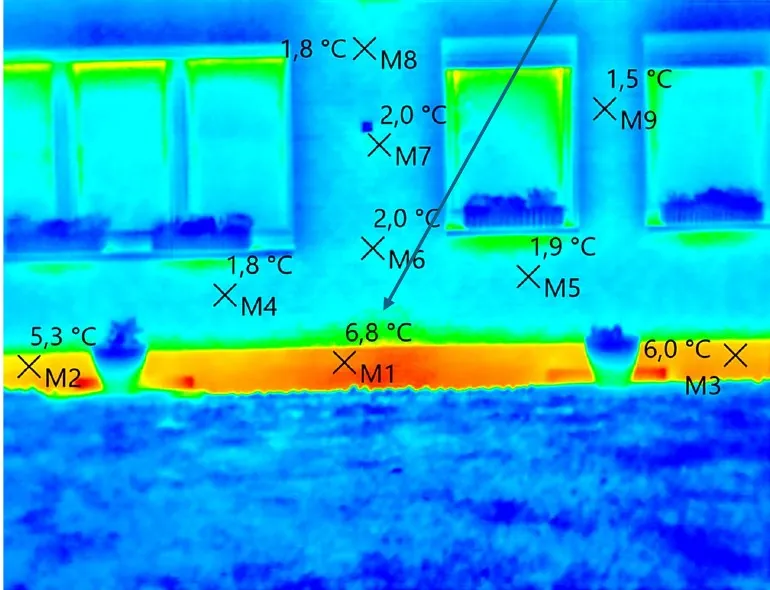
Expert evaluation by Ingo Büser (building preservation expert, certified expert for moisture and mold damage): Thermal images of a residential building coated with the thermo-reflective facade, each taken in the morning before sunrise without solar radiation, on 9 March 2026 (before coating) and 15 April 2026 (approximately two weeks after coating on 31 March 2026), at nearly identical outdoor temperatures (2–3 °C and 4–5 °C respectively) and thus comparable measurement conditions.
Application of the coating at the model house, March/April 2026Thermal image, gable side basement, before coating (09.03.2026)Thermal image, gable side basement, after coating (15.04.2026)
Exterior surface temperature, gable side (southeast), 09.03.2026 (before coating)
2,5–3,9 °C
Exterior surface temperature, gable side (southeast), 15.04.2026 (after coating)
0,5–2,0 °C
Exterior surface temperature, garden side (southwest), 09.03.2026 (before coating)
4,0–5,4 °C
Exterior surface temperature, garden side (southwest), 15.04.2026 (after coating)
1,7–3,3 °C
Calculated reduction in heat loss vs. uncoated wall (model calculation, page 4)
80–90 %
Result: Between the two measurement dates, the difference between wall surface and outdoor air temperature dropped significantly at all measurement points (e.g. gable side basement plinth M8: 2.8 → 1.8 °C; gable peak upper floor M12/M9: 2.5 → 0.7 °C; garden wall M2/M1: 5.4 → 2.3 °C) – the surface is thus approaching the physical limit temperature (= outdoor air temperature). Since the coating was applied on 31 March 2026, this represents a genuine before-after comparison measured on the same building (9 March before, 15 April approximately two weeks after coating). The after-measurement captures only an early interim state: according to the report, complete drying/curing of the wall takes about another 3 months; the insulating effect is expected to improve further over the following winter. Differences between the gable and garden sides can be explained by wind exposure and orientation, not by inadequate insulation performance. At the plinth, there was no indication of dew point undershoot or mold risk.
The coating was applied on 31 March 2026 – between the two measurement dates (9 March and 15 April 2026). This therefore constitutes a before-after comparison on the same building. The application date (31 March 2026) is from project data. The passage "reduction in heat loss by 80–90%" (page 4 of the document) remains a separate, model-based (calculated) comparison with rounded model values (7–8 °C / 3.5–5.5 °C / 0.5–2.5 °C).
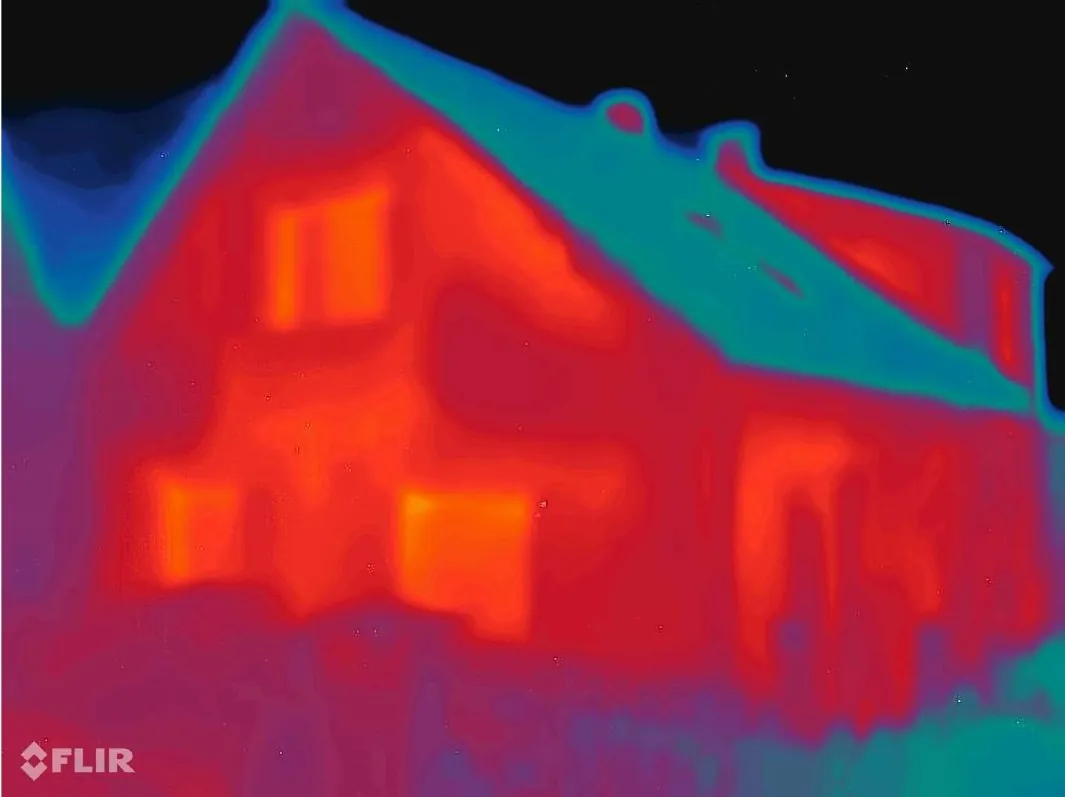
Before-after comparison published by PSCoat on its own website: Thermographic images of a residential building before and after coating with PS-Coat, taken under comparable winter conditions (approx. +2 °C to +5 °C outdoor temperature). According to the source, the building required high heating output before coating and still failed to reach satisfactory room temperatures. In the right-hand roof area and around a dormer, surfaces were left untreated and serve as a direct reference area within the same building (same weather, same indoor temperature, same construction).
Thermal image before coatingThermal image before coating, with uncoated roof area as reference
Outdoor temperature at time of recording
ca. +2 bis +5 °C
Energy efficiency class (actual heat pump consumption)
B statt G
Result: The coated facade surfaces appear noticeably cooler in the thermal image, while windows and other thermal bridges stand out more strongly and the (uncoated) roof appears as the dominant heat loss area. The untreated reference areas in the roof/dormer area, by contrast, remain noticeably warmer. According to PSCoat, higher indoor temperatures were achieved with lower energy input; the actual consumption data of the heat pump corresponds to a level usually associated with very well insulated buildings (energy class B instead of G).
Manufacturer's own presentation on psco.at/messungen. The page additionally shows a bar chart (months "02"–"06") with declining values (approx. 627 down to below 100). As an exterior, renderable facade coating, the product is classified here as BUILD (FAS system).
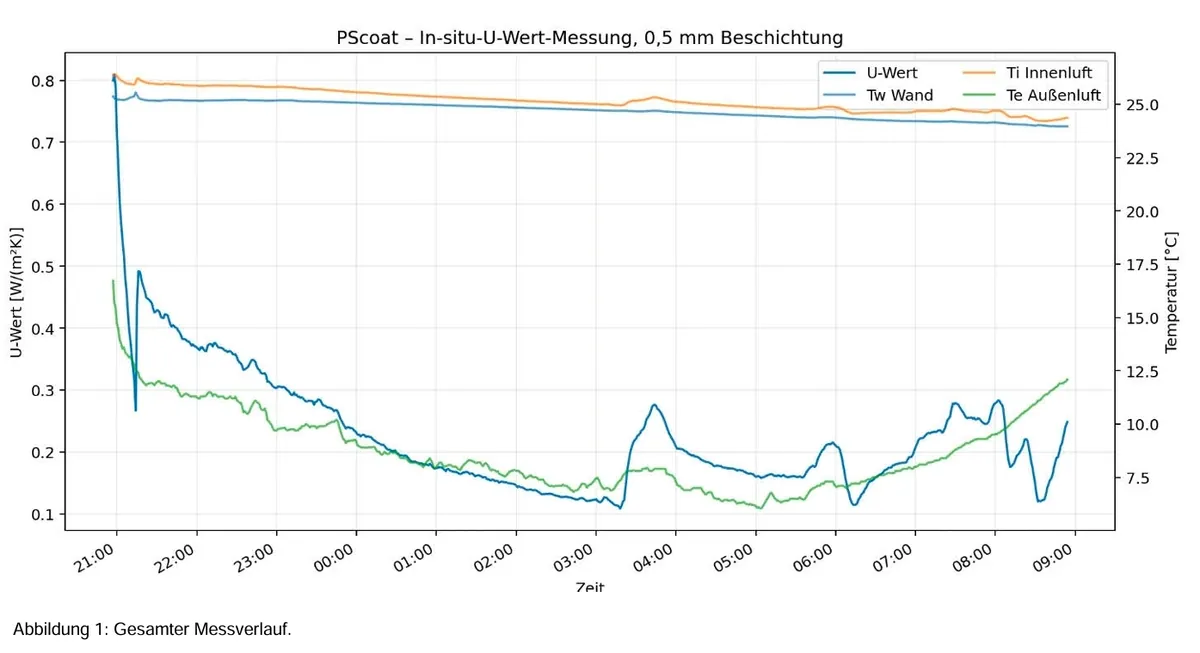
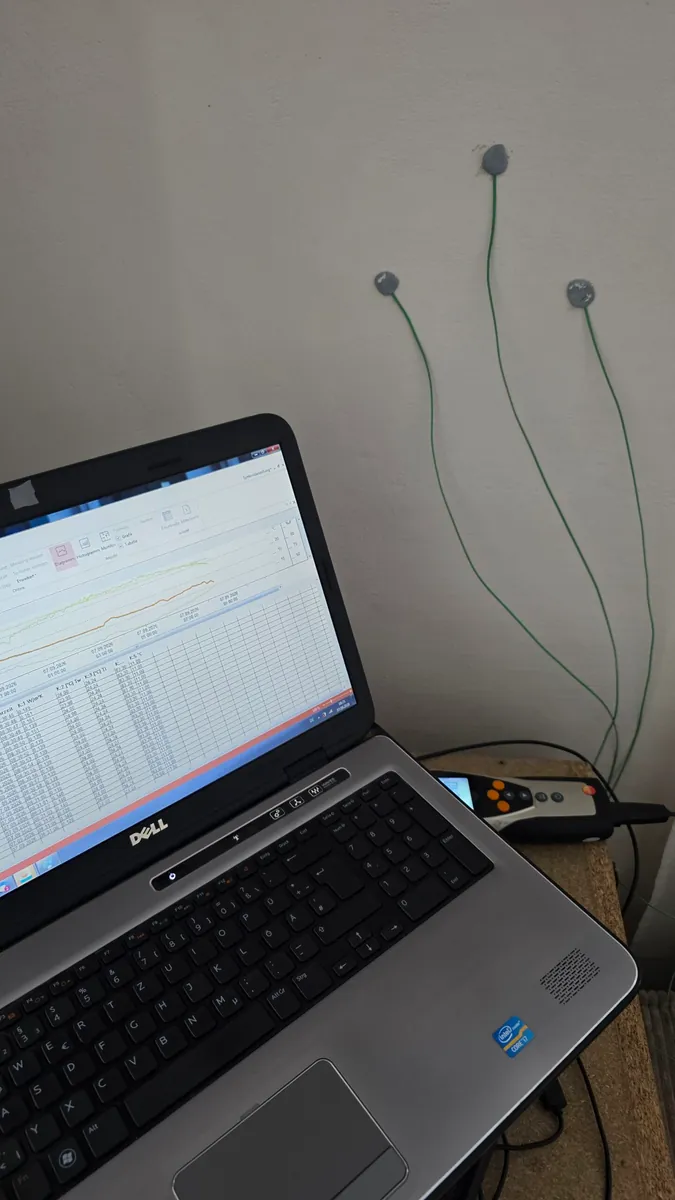
Continuous in-situ U-value recording (Testo 635-2 with U-value kit) on a real historic solid-masonry wall treated with approx. 0.5 mm PScoat. Wall structure from outside to inside: PScoat coating, approx. 5 mm reinforcement mortar with mesh, cement / lime-cement plaster, three-layer historic solid brick masonry, interior cement plaster and standard acrylic wall paint. Coating applied in April 2025 (approx. 18 l over approx. 35 m²). Recorded over 11 h 57 min with 42,978 usable data sets; heating off, windows closed, no air movement after 23:00.
Measurement curve: U-value and temperatures (Ti/Tw/Te), 21:00–09:00Measurement setup: Testo 635-2, wall sensors and continuous recording
Measurement system
Testo 635-2 + U-Wert-Kit (kontinuierlich)
Measurement period / data sets
06.09.2026 20:57 – 07.09.2026 08:54 (11 h 57 min), 42.978
PScoat layer thickness
ca. 0,5 mm
U-value, stable window 01:15–03:15
0,140 W/(m²K) (Median 0,139; Min. 0,105; Max. 0,177)
U-value, late measurement phase from 05:00
0,195 W/(m²K) (Median 0,183)
Derived equivalent λ comparison value of the coating
rund 0,0001 W/(m·K)
Result: Over several hours the Testo system output reproducibly low U-values on the treated wall; in the stable evaluation window 01:15–03:15 an average of 0.140 W/(m²K). From the measured component behaviour — assuming a baseline U-value of 1.60 W/(m²K) for the uncoated wall — an equivalent lambda comparison value of about 0.0001 W/(m·K) can be back-calculated for the 0.5 mm coating (0.000114 W/(m·K) referred to the target value U = 0.20 W/(m²K)).
Manufacturer's own technical measurement report (measurement ID PSC-U-2026-001). The derived lambda value is an equivalent comparison value back-calculated from the in-situ component measurement, not an intrinsic property determined separately to a material standard; the baseline U-value of 1.60 W/(m²K) was not measured before coating but assumed as a technically plausible reference value. The measurement applies only to the examined component under the documented boundary conditions and does not replace accredited laboratory testing, certification or building-authority assessment.
Manufacturer's own 24-hour comparison setup for the energy consumption of similar test specimens with different treatment: untreated reference, PScoat coating, 100 mm polystyrene (EPS) and PScoat combined with a facade coating.
Reference (untreated)
6,58 kWh / 24 h
PScoat coating
4,38 kWh / 24 h (−33,4 %)
100 mm polystyrene (EPS)
4,48 kWh / 24 h (−31,9 %)
PScoat + facade coating
4,08 kWh / 24 h (−38,0 %)
Result: In the setup described, the 24-hour energy consumption of the PScoat specimen was, according to PSCoat, at a similar level to that of a specimen insulated with 100 mm EPS; the PScoat + facade coating combination showed the lowest consumption.
Manufacturer's own presentation on the PScoat website ("Infos" section). Controlled comparison setup without a separate, accredited test report; the values are manufacturer's figures and apply to the described test setup. Not transferable to specific components or buildings without qualified, object-specific assessment; does not replace accredited laboratory testing, certification or building-authority assessment.
Interior insulation of an operations room at BILLA (REWE Group)
BILLA, spol. s r.o. (REWE Group Česká republika) · Installation:RIVER POWER s.r.o. (Applikation)
Signed confirmation from REWE Group Česká republika / BILLA, spol. s r.o.: The operations manager's room was inadequately insulated; in winter, indoor temperatures were only 6–12 °C (with outdoor temperatures around 0 °C or below). On 20 January 2023, PScoat was applied as a 1 mm thick, thermo-reflective spray coating to the walls and ceiling (additionally to two exterior walls from the outside), without any change to the heating system.
Indoor temperature before coating (winter)
6–12 °C
Outdoor temperature during observation period
ca. 0 °C oder darunter
Layer thickness
1 mm
Indoor temperature after coating (winter)
19–21 °C
Result: According to daily temperature monitoring, the indoor temperature rose to 19–21 °C after coating, with the heating system and method unchanged. Confirmed and signed by Petr Vašek (TAB manager BILLA) and Josef Štafa (energy manager REWE Group Česká republika).
The stated layer thickness of 1 mm corresponds to the layer thickness specified for BUILD/BUILD INTERIOR (1.0 mm in 2 × 0.5 mm) – classified here as BUILD INTERIOR as an interior application. Application was carried out by RIVER POWER s.r.o.
Interior insulation of a church and chapel (3,700 m²)
Pfarrei St. Josef, Bielsko-Biała (Polen) · Installation:RIVER POWER s.r.o. (Lieferant)
Reference letter from the parish priest, ks. Stanisław Wójcik: PSC nano thermal insulation coating was applied in February 2019 to the interior walls of St. Joseph's Parish Church (3,100 m²) and the adjoining Marian Chapel (600 m²) – a total of 3,700 m² of surface area.
Coated area, church
3.100 m²
Coated area, chapel
600 m²
Result: The application was carried out professionally, and the expected insulation effect was achieved. A clear improvement in temperature and microclimate is noticeable in both the church and the chapel, in winter as well as in summer. The material and application team are explicitly recommended.
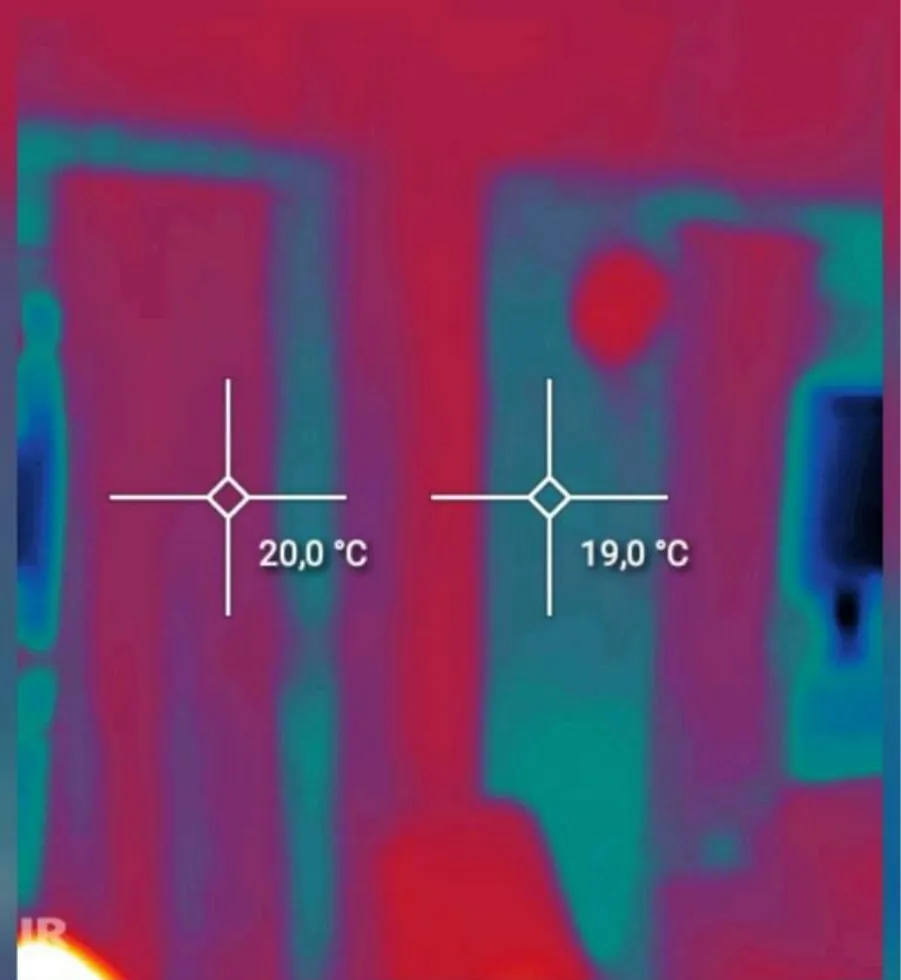
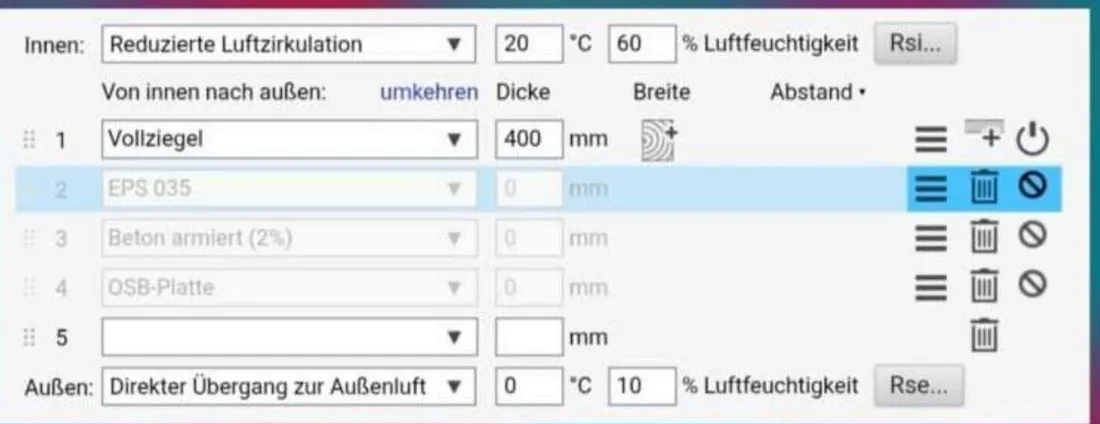
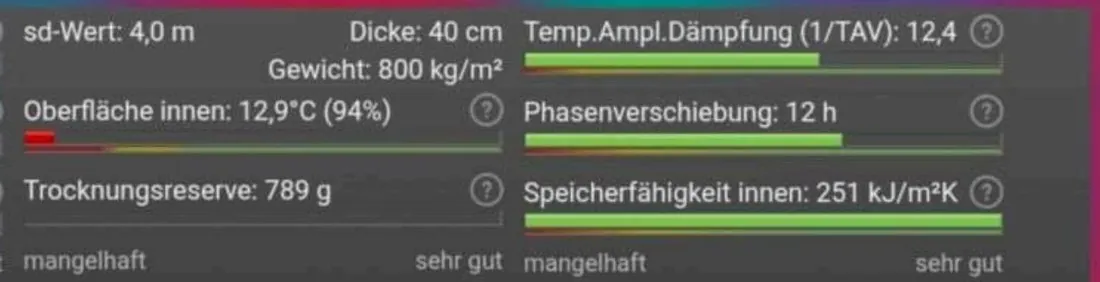
Measurement example on a 40 cm thick solid brick wall (built 1900, infrared heating system) at 0 °C outdoor temperature. A building physics calculation (Ubakus, wall structure: 40 cm solid brick, without a PScoat layer in the model) yields a calculated interior surface value of 12.9 °C ("inadequate"). A surface temperature of approx. 19–20 °C was measured on the wall actually coated with PScoat.
Thermal image of the coated wall surface, 19–20 °C measuredUbakus wall structure: 40 cm solid brick, without PScoat layer in the modelUbakus result: calculated interior surface temperature 12.9 °C ("inadequate")
Wall structure
40 cm Vollziegel, Baujahr 1900
Outdoor temperature
0 °C
Wall surface temperature, calculated without PScoat (Ubakus)
12,9 °C
Wall surface temperature, measured with PScoat
19–20 °C
Result: The measured wall surface temperature is around 6–7 K above the value calculated for the uncoated wall. According to PSCoat, the theoretically expected interior wall temperature diverges significantly from the actual measured value.
Manufacturer's own presentation on psco.at/messungen. The Ubakus calculation screenshot shown depicts only the wall without the PScoat layer (comparison is "measured with coating" against "calculated without coating in the model").
Concrete skeleton construction: U-value verification with PScoat layer approaching passive house level
PSCoat – Herstellerbeispiel (Betonskelettbau mit Ziegelausmauerung, psco.at/messungen)
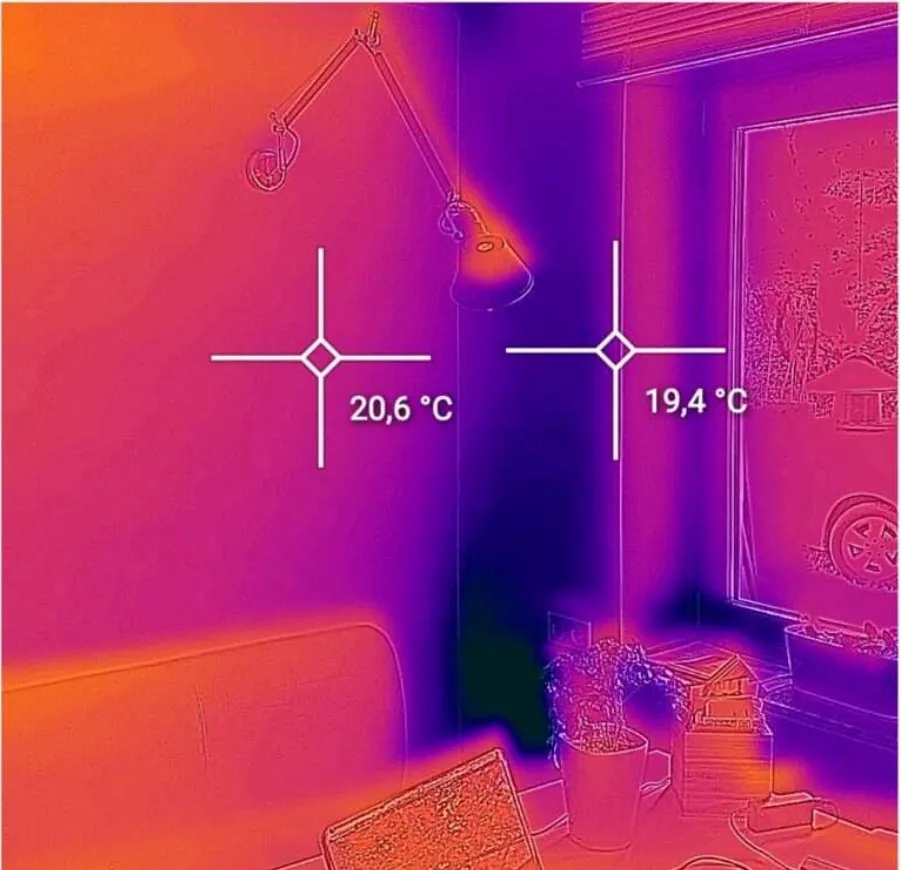
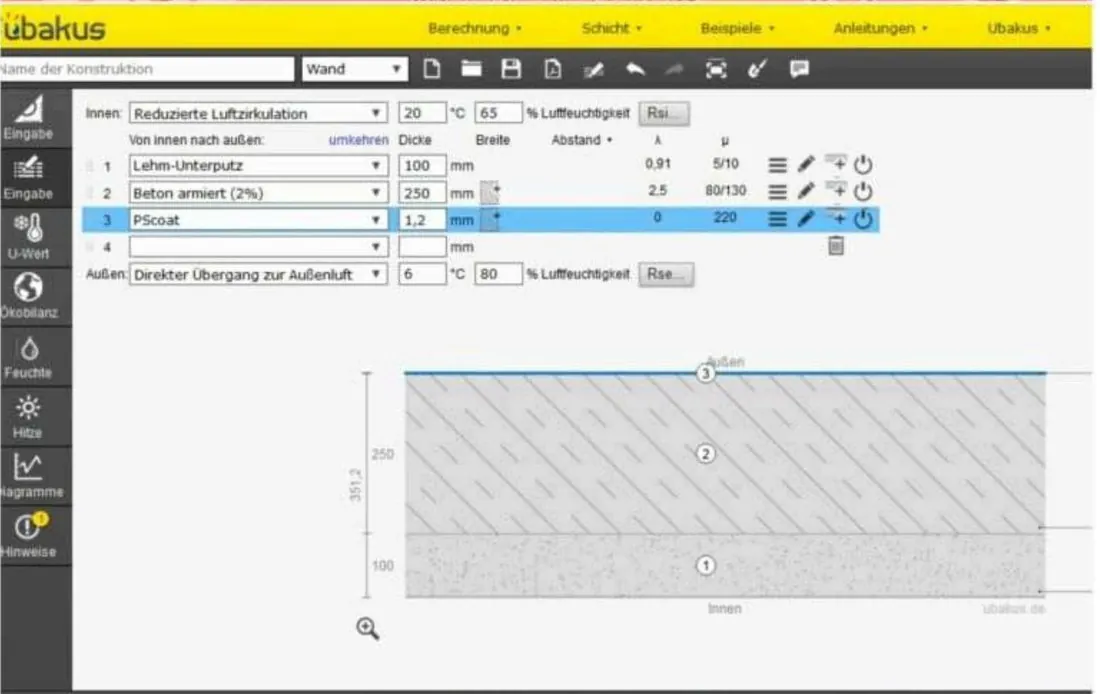
Measurement example on a concrete skeleton building with brick infill, which had mold problems from condensation before coating. At 3 °C outdoor temperature, an interior surface temperature of 19.4 °C was measured, compared to an "expected" (naively calculated) temperature of 12 °C. In addition, an Ubakus calculation that includes a 1.2 mm thick PScoat layer as part of the wall structure (clay base render 100 mm, reinforced concrete 250 mm, PScoat 1.2 mm) shows a U-value of 0.096 W/(m²K) – well below the GEG 2020 threshold for existing buildings (≤ 0.24 W/(m²K)) – as well as a calculated interior surface temperature of 19.7 °C with 0 kg/m² of condensation.
Thermal image of the coated wall surface, 19.4 °C measuredUbakus wall structure: clay base render, reinforced concrete (250 mm), PScoat (1.2 mm)Ubakus result: U-value 0.096 W/(m²K), interior surface temperature 19.7 °C
Outdoor temperature
3 °C
Interior surface temperature, "expected" (without PScoat in the model)
U-value of the wall structure incl. 1.2 mm PScoat (Ubakus)
0,096 W/(m²K)
Interior surface temperature, calculated with PScoat in the model (Ubakus)
19,7 °C
Condensation (Ubakus)
0 kg/m²
Result: When the PScoat layer is correctly included in the building physics calculation (Ubakus), the calculated value for the interior surface temperature (19.7 °C) is very close to the actually measured value (19.4 °C) – unlike a calculation that does not account for the coating, which would be far too low at 12 °C. The resulting U-value of 0.096 W/(m²K) significantly undercuts the GEG 2020 requirement for existing buildings (0.24 W/(m²K)); according to PSCoat, this gives the concrete skeleton building "passive house character".
Manufacturer's own presentation on psco.at/messungen. The association between the U-value calculation (Ubakus screenshot) and the passage "concrete skeleton construction .../expected 12 °C, measured 19.4 °C" is inferred from the page layout (matching construction type "reinforced concrete").
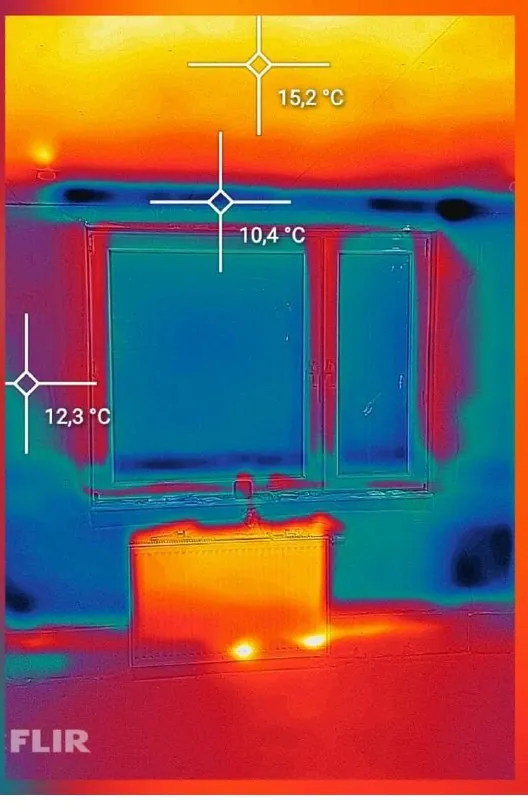
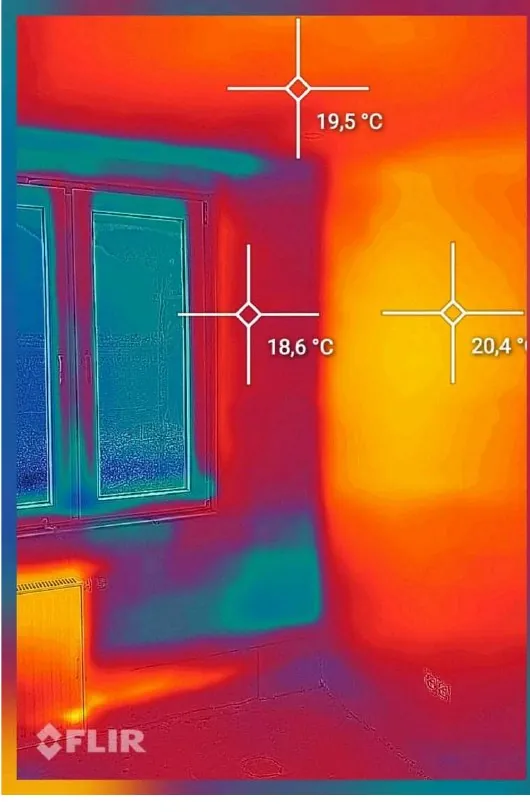
Before-after comparison from inside the same room, at identical flow temperature (36 °C) and comparable outdoor temperatures (−5 °C before, −3 °C after). According to PSCoat, the room and windows are identical in both images.
Thermal image before (−5 °C outdoor, 36 °C flow temperature)Thermal image after (−3 °C outdoor, 36 °C flow temperature)
Outdoor temperature, before
−5 °C
Outdoor temperature, after
−3 °C
Flow temperature (before/after, identical)
36 °C
Wall surface temperature (thermal image), before
ca. 10–15 °C
Wall surface temperature (thermal image), after
ca. 19–20 °C
Result: At identical flow temperature and despite a colder outdoor temperature before (−5 °C vs. −3 °C after), significantly higher room and interior surface temperatures were measured after coating: the points marked in the thermal image are at approx. 18.6–20.4 °C afterward, compared to only approx. 10.4–15.2 °C before.
Manufacturer's own presentation on psco.at/messungen.
Roof renovation with reflective thermal insulation
Gospodarstwo Rolne Bożena Butor-Fleszar, Łany Wielkie (Polen) · Installation:RIVER POWER s.r.o. (Lieferant)
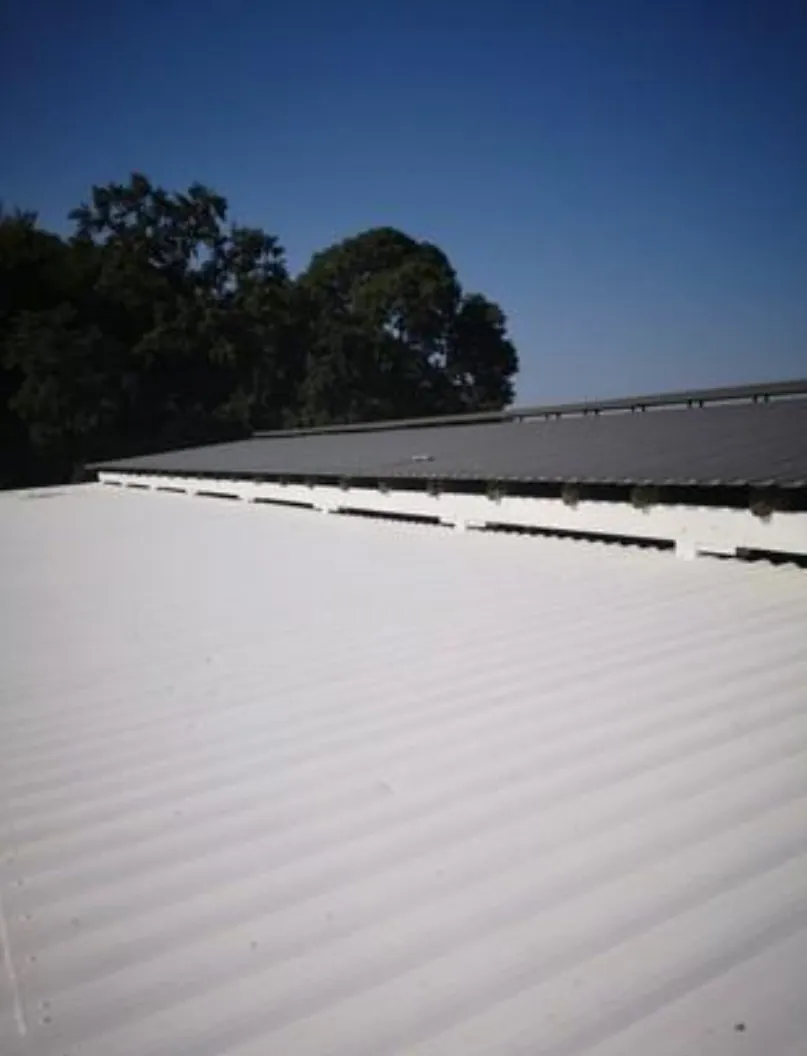
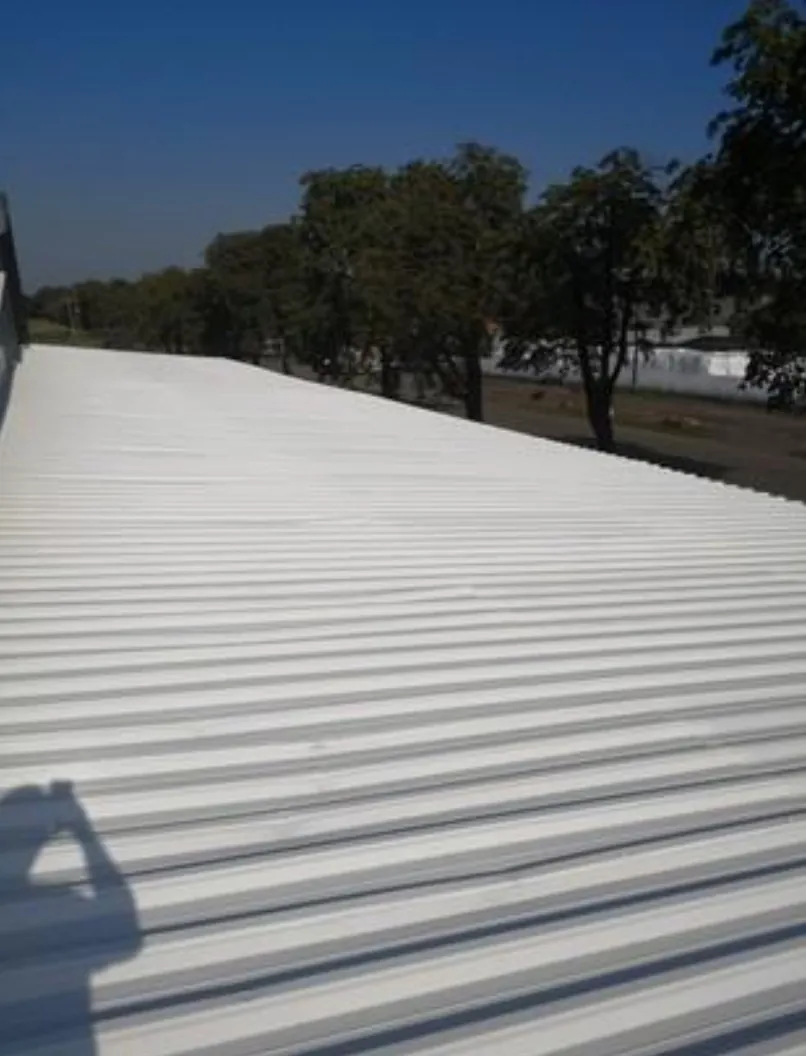
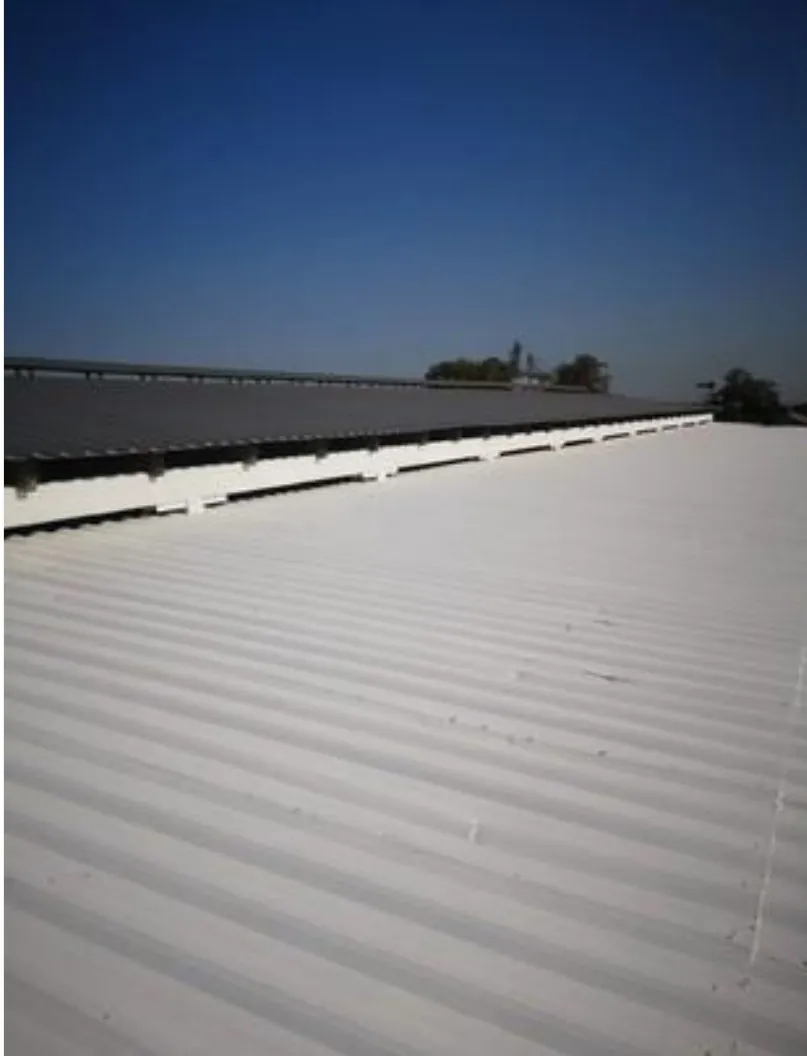
Recommendation letter from Krzysztof Fleszar (Vice President): After a failed roof renovation with a competitor product (material detached from the roof, thermo-reflective properties fell far short of manufacturer claims), PSC "Power Smart Coat" was applied to the roof starting in May 2018.
Coated roof of the cow farm in SośnicowiceRoof surface after PSC coatingRoof surface after PSC coating, view toward the eaves
Temperature reduction after PSC coating
ca. 10 °C
Result: The PSC coating solved the overheating problem: the temperature dropped by around 10 °C, and the coating adheres fully to the roof. The customer explicitly recommends RIVER POWER as a reliable partner for thermal insulation work.
Classified here as ECR ROOF as a reflective roof top coat. A PSCoat company presentation (pscoat-vorstellung-referenzen.pdf) shows additional photos of the same site ("Butor agricultural operation – Poland", cow farm roof in Sośnicowice; Łany Wielkie is located in the Gmina Sośnicowice) and adds a further benefit: after coating, the roof temperature approached ambient temperature, which improved cow efficiency in summer.
Continental (Reifenwerk) · Installation:zumm s.r.o., Dolní Němčí (Tschechien)
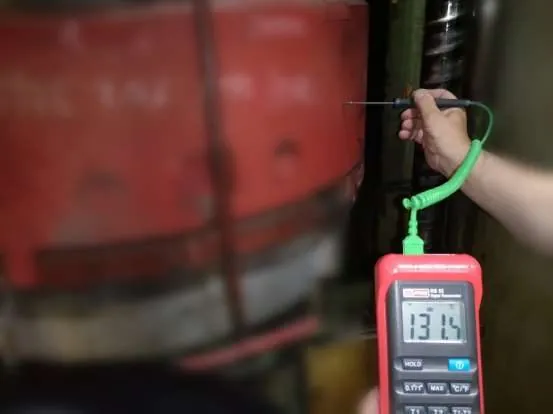
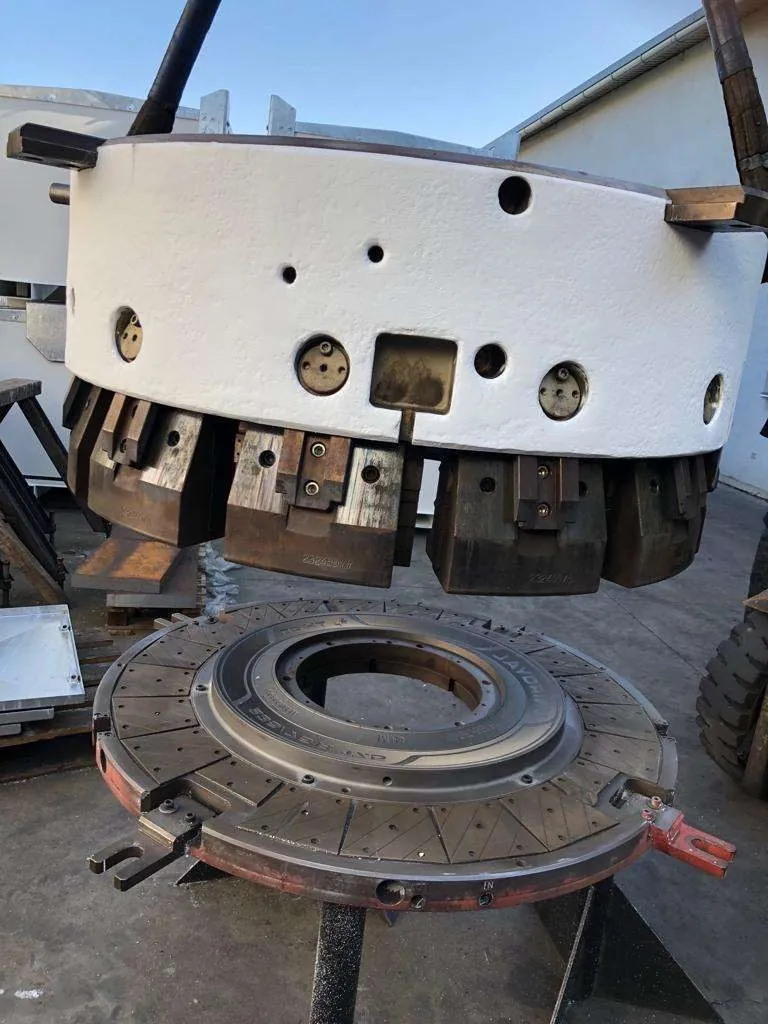
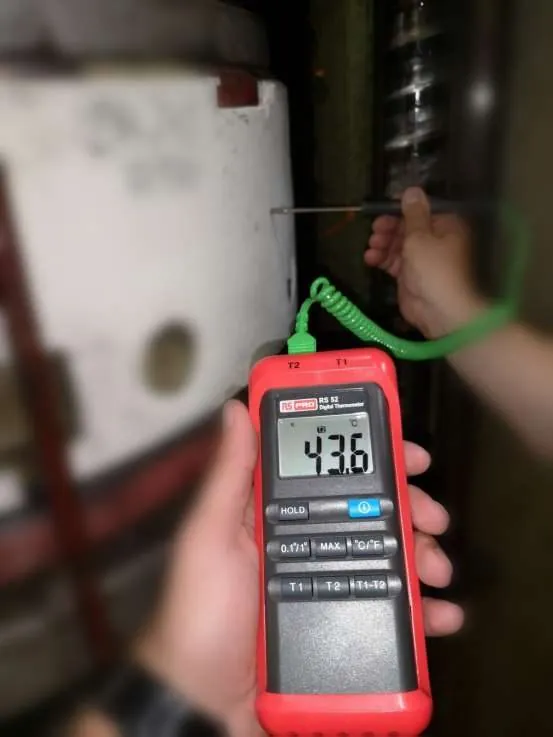
Insulation of a mold container (type AS410 HS Flex Cont. Steamplate, 410 × 1170 mm) with PSCoat to reduce the surface temperature of a tire vulcanization mold. The primary goal was workplace safety (burn protection), with energy savings as a secondary objective.
Measurement 1: 131.4 °C surface temperature without insulationApplication: mold container after PSCoat coatingMeasurement 3: 43.6 °C surface temperature insulated with PSCoat
Surface temperature without insulation (1)
131,4 °C
Surface temperature without insulation (2)
128,6 °C
Surface temperature insulated with PSCoat (1)
43,6 °C
Surface temperature insulated with PSCoat (2)
40,4 °C
Result: The surface temperature dropped on average from approx. 130 °C to approx. 42 °C. According to the customer, this represents significantly greater safety at the equipment as well as relevant energy savings; the entire installation in one hall was subsequently to be fully insulated.
The source document names only "PSCoat" without specifying the exact product variant. Given the operating temperature (> 130 °C) and application context (industrial plant), HP+ (surface temperature suitability up to 220 °C) is the most plausible assignment – not confirmed by the document itself.
Thermal bridge insulation of military transport containers
VÝVOJ Martin, a.s. (Mitglied MSM Group) – für einen militärischen Endkunden · Installation:Alpha Construction AG, Zug (Schweiz) (Vertrieb/Lieferant)
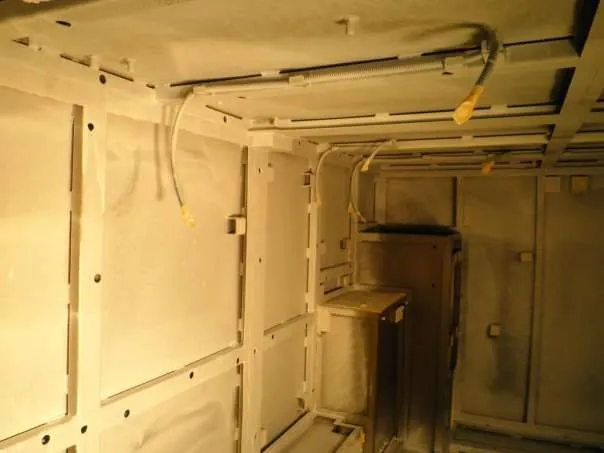
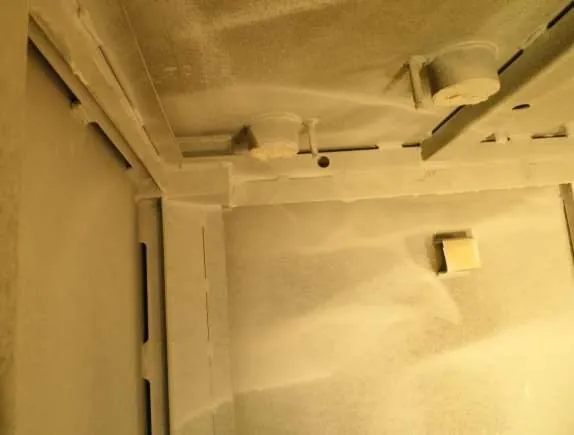
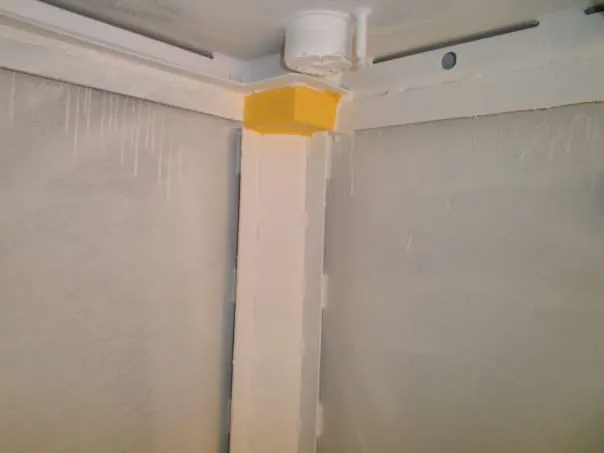
Reference letter no. VMT-1/2018 from VÝVOJ Martin, a.s. (ISO 9001/3834/18001 certified): PSCoat was applied to the interior of welded steel containers – specifically at thermal bridges, corners, main frames, and supports. The containers are used by a military customer across various climate zones in the EMEA region.
Attachment 1: coated interior (ceiling/frame) of the containerAttachment 2: corner area with treated thermal bridgeAttachment 3: corner post – thermal bridge detail
Climate test conditions
+49 °C / 95 % relative Luftfeuchte
Dew point formation at thermal bridges after coating
keine
Number of coated containers
180
Warranty claims
keine
Result: After application, climate tests (+49 °C, 95% humidity) showed no more dew points forming in the thermal bridge areas. The coating was applied to 180 containers for a military customer, deployed across various climate zones in the EMEA region, with no warranty claims to date.
The source document names the product as "PCS-250T-HP" – classified here as PSC 250 T HP+ (hpPlus) analogous to the Continental reference, which uses the same product for comparable industrial applications.
Thermal protection of a fermenter tank (bioenergy plant)
VAE Controls – Plynex Slovakia s.r.o.
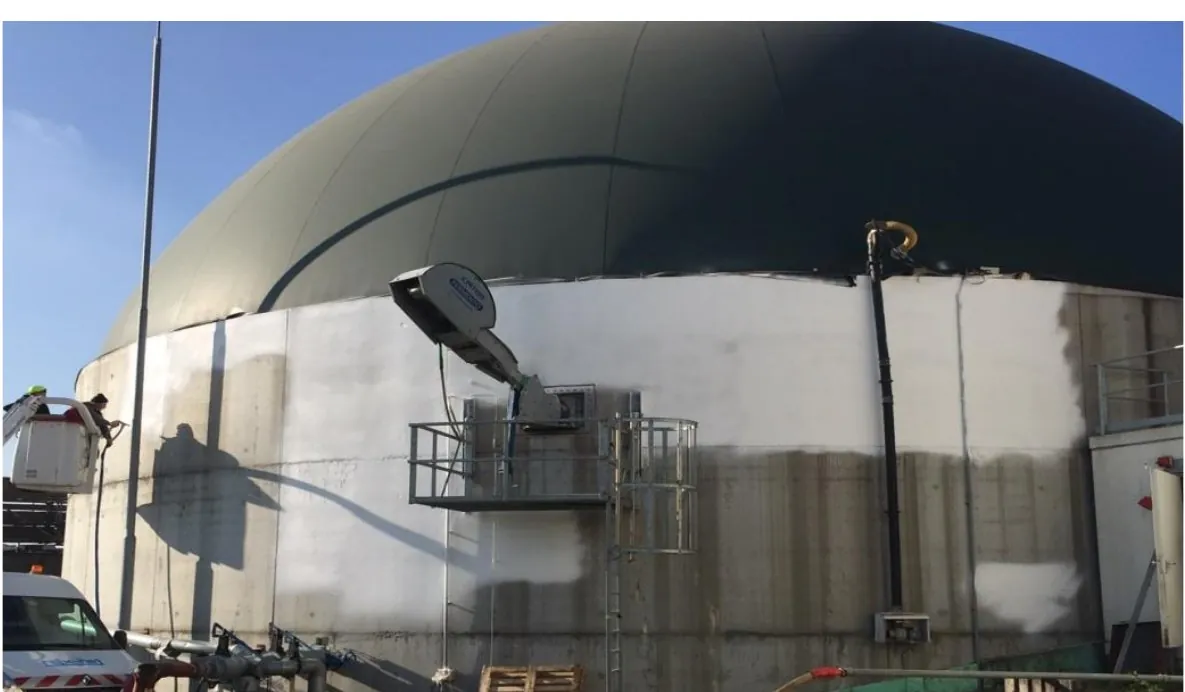
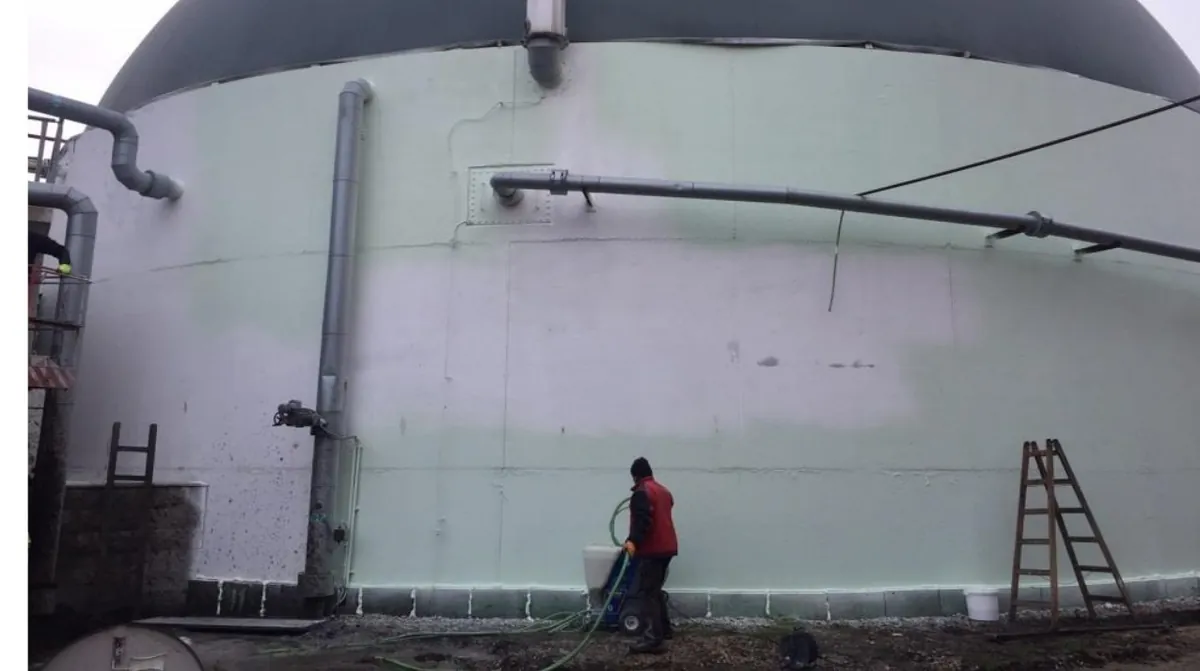
Reference letter from VAE Controls (Martin Pecina, General Manager, Member of the Board of Directors): PSC was applied in 2016 to the concrete tank of a fermenter at a bioenergy plant. The goal was thermal protection of the tank and ensuring a constant working temperature for the fermentation process during low winter outdoor temperatures.
Result: According to the customer, the application met expectations in all technical respects; the fermentation process has run smoothly ever since. The coating has not changed its properties and technical parameters since.
Qualitative customer confirmation. Product assignment (HP+) derived from the industrial/tank application context.
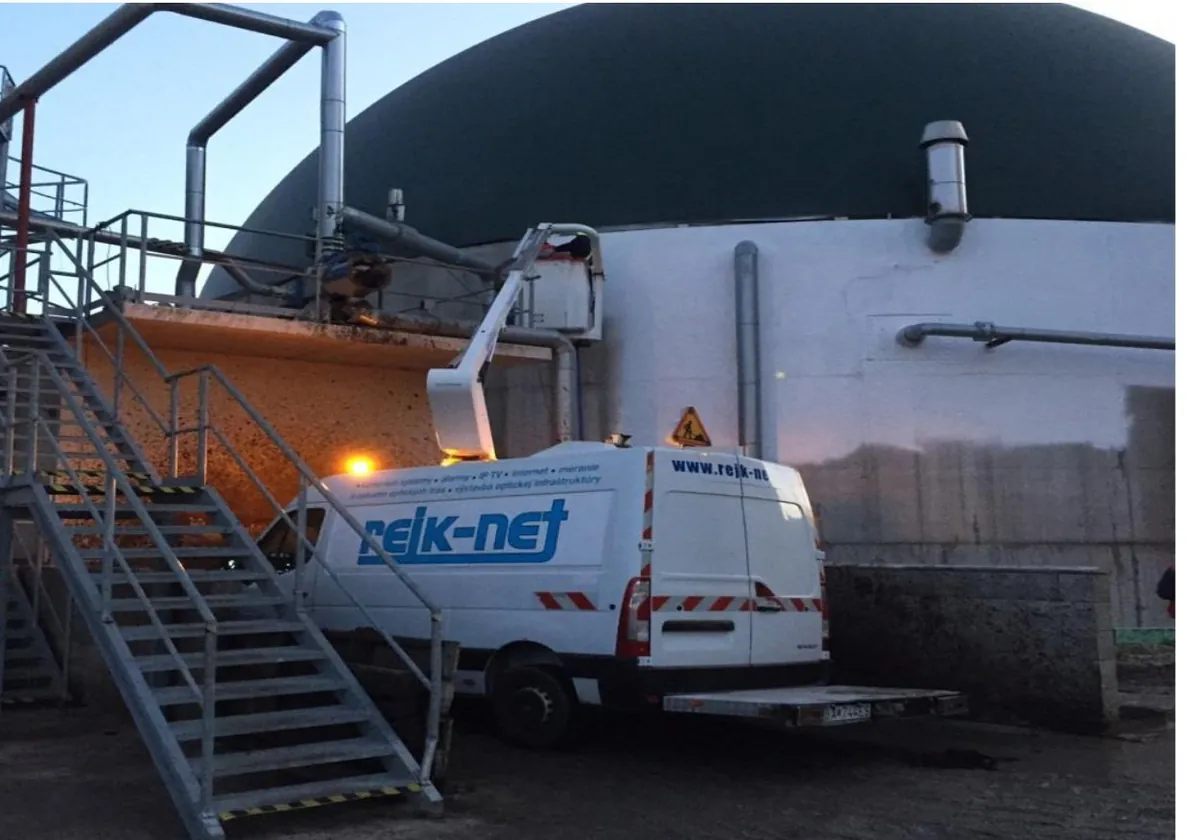
PSC was applied to the concrete dome tanks of a biogas plant. Screenshots of the process control system (13 January 2017) as well as a meteoblue weather archive for the Sereď (Slovakia) site document a 24-hour temperature measurement of the fermenter medium during winter outdoor temperatures.
Application of PSC to the concrete tank of the fermenterApplication of the PSC coating to the tank wallCompleted coated tank area with aerial work platform
Temperature drop of fermenter medium over 24 h
0,4 °C
Outdoor temperature during measurement period
−15 °C
Medium temperature (fermenter contents)
33 °C
Result: According to the enclosed process control system records, the temperature of the fermenter medium dropped by only 0.4 °C within 24 hours at an outdoor temperature of −15 °C – an indication of effective thermal insulation of the tank by the PSC coating.
Possibly the same or another plant of VAE Controls as the separately documented reference "Thermal protection of a fermenter tank" (2016) – the Sereď location and the process data screenshots suggest an independent project, though this cannot be conclusively determined from the source documents. Product assignment (HP+) derived analogously to the existing VAE Controls entry.
Thermal imaging measurement on a 220°C steam pipeline
Grupa Azoty S.A. (Polen)
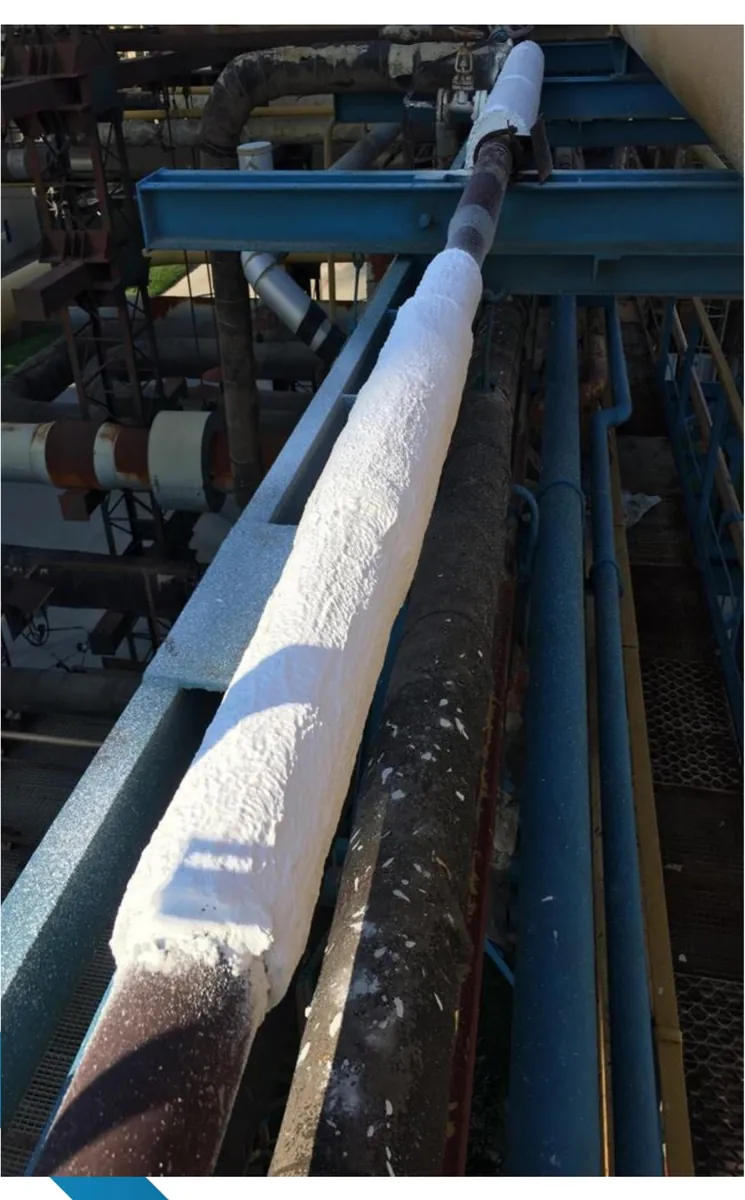
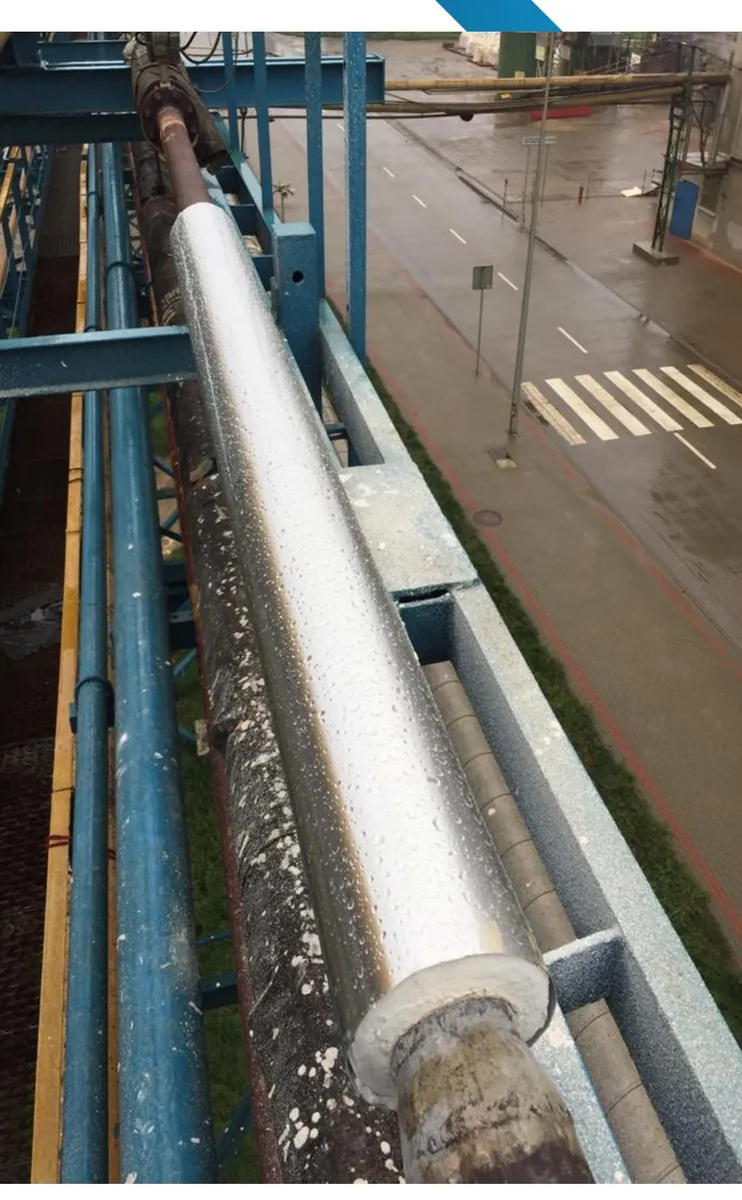
Signed thermal imaging measurement protocol (mgr inż. Zbigniew Paprocki, Head of Office, Production Safety Management and Coordination Office): On a steam pipeline (0.9 MPa, medium temperature 220 °C, string XI), a roughly 1500 mm long measurement section between two uninsulated flange ends was examined – one half coated with the PSC system, the other half with a primer + PSC system.
Coated steam pipeline on steel structure within the plant areaCoated steam pipeline along its route
Medium temperature, steam pipeline
220 °C (0,9 MPa, Strang XI)
Surface temperature in PSC-system area (measurement points)
26 °C / 40 °C
Surface temperature in primer+PSC-system area (measurement points)
25,7 °C / 45 °C
Result: According to the signed thermal imaging measurement protocol, both PSC system variants kept the surface temperature of the 220 °C steam pipeline predominantly in the range of approximately 26–45 °C along the measurement section.
Handwritten thermal imaging measurement protocol from a PSCoat company presentation; an additional comparison table shown, "Insulation loss" (old glass wool insulation vs. "first PSC sample"), is not explained in the source document and is deliberately not interpreted here. Product assignment (HP+) derived from the industrial piping application context.
Koksownia Częstochowa Nowa Sp. z o.o. · Installation:ARWEKON Sebastian Grabowski (Izolacje Techniczne)
Reference letter from Koksownia Częstochowa Nowa (Robert Paszak, Vice President/Technical Director) along with confirmation from the executing insulation contractor ARWEKON: PSC was applied in March 2017 to valves of the thermal oil system in the boiler house of the benzene plant department, as a replacement for conventional insulation boxes.
Result: According to the customer, the coating fully met the thermal insulation requirements of the valves and replaced the traditionally used insulation boxes. No change in properties or technical parameters since application. ARWEKON additionally confirms a similar application in 2016 on the gas pipeline and steam valves of the coking plant, with significantly shorter execution time compared to mineral wool insulation.
Qualitative confirmation. Product assignment (HP+) derived from the industrial valve application context.
Reference letter from AmpluServis, a.s. (Ing. Miroslav Pajchl, Director), part of the Veolia Group: PSC "Power Smart Paint" was applied as a 3 mm thick coating to hot water pipes (thermal insulation) and cold water pipes (condensation protection) at the Třebovice combined heat and power plant.
Hot water pipe, before coating
87 °C
Hot water pipe, after coating
47 °C
Cold water pipe, before coating
mit Kondensatbildung
Cold water pipe, after coating
ohne Kondensatbildung
Result: The surface temperature of the hot water pipe dropped from 87 °C to 47 °C; the cold water pipe no longer showed condensation formation after coating. The customer is very satisfied with the result and plans to use it for preserving further installations.
Extensively documented application (Rudolf Edlmayer, Head of Maintenance): PSC 250 HP was applied to the hot water pipeline (135 m³/h, 80–85 °C), at measuring points, flanges, and other connection points where conventional mineral wool/sheet metal insulation was impractical due to the many fittings. Applied by brush in 3 coats, approx. 2–3 mm.
Application point at the heat exchanger of the pipelineTemperature measurement using a certified contact thermometer
Water temperature in the pipeline
80 °C
Surface temperature without PSC insulation
61,2 °C
Surface temperature with PSC insulation
32,2 °C
Result: The surface temperature dropped by almost 30 °C – according to the customer, a "great result." Experience: easy application, fast drying on hot surfaces, high insulation factor, water resistant, easy to touch up. Energiabörze explicitly recommends PSC for low-temperature surface insulation and would like to see approval for higher temperature ranges.
Synthos Dwory 7 sp. z o.o. sp. jawna (Oświęcim, Polen)
Reference letter from Synthos (Sławomir Czuchrij, Director of the Energy Department): PSC was applied in June 2016 to a post-sulfite liquor tank. The goal was thermal and corrosion protection of the tank under difficult operating conditions.
Result: According to the customer, the application met expectations in all technical respects. The coating has not changed its properties and technical parameters since.
Qualitative customer confirmation. Product assignment (HP+) derived from the industrial/tank application context.
Measurement protocol: insulation performance at a pipe flange (130 °C)
DEZA a.s., Velké Meziříčí (Tschechien) · Installation:Ing. Jean Kocian (River Power) und Ing. Vlastimil Horák (DEZA, Betriebsleiter) – gemeinsame Prüfkommission
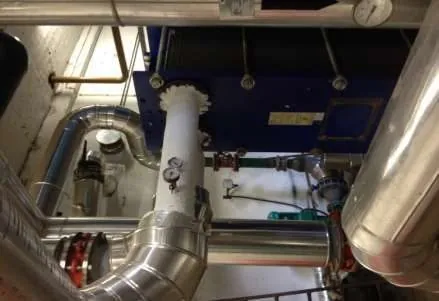
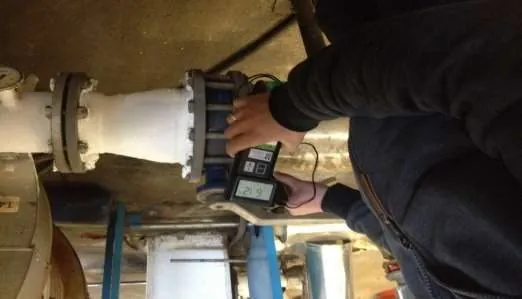
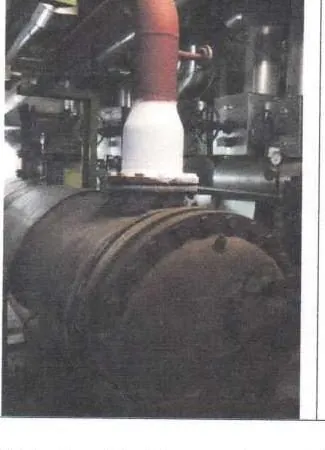
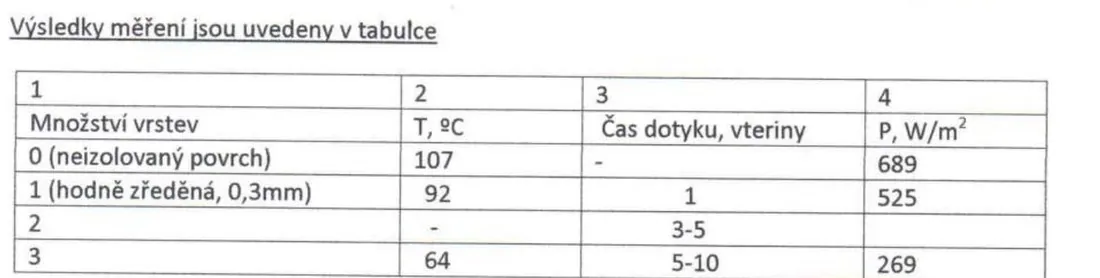
Formal test protocol "Protokol zkoušek tepelně izolačních vlastností produktu Power Smart Coat (PSC)": Application to the flange of a hot water line (water temperature +130 °C) at the heat exchanger of the energy department, during ongoing operation. Measurement with a contact thermometer (Volfcraft Thermostick DOT 300) at 0/1/3 applied coats (0.3–0.5 mm each).
Application point: flange of the hot water line (130 °C)Measurement results from the test protocol: temperature and heat flux density at 0/1/3 coats of PSC
Surface temperature without coating
107 °C / 689 W/m²
Surface temperature after 1 coat (heavily diluted, 0.3 mm)
92 °C / 525 W/m²
Surface temperature after 3 coats
64 °C / 269 W/m²
Result: The heat flux density (calculated per Stefan-Boltzmann, ε = 0.93) dropped from 689 W/m² (uncoated) to 269 W/m² at three coats – a reduction of around 61%. According to the protocol, PSC shows clear insulating properties and is suitable for installations with a continuous operating surface temperature of up to 200 °C, briefly up to 250 °C – particularly for reducing heat losses and protecting employees from burns.
IND · Juli 2019 (Technischer Bericht vom 05.08.2019)
Corrosion remediation of a gasoline tank by replacing mineral wool insulation
SLOVNAFT MONTÁŽE A OPRAVY, a.s. – Terminál Kapušany (Slowakei)
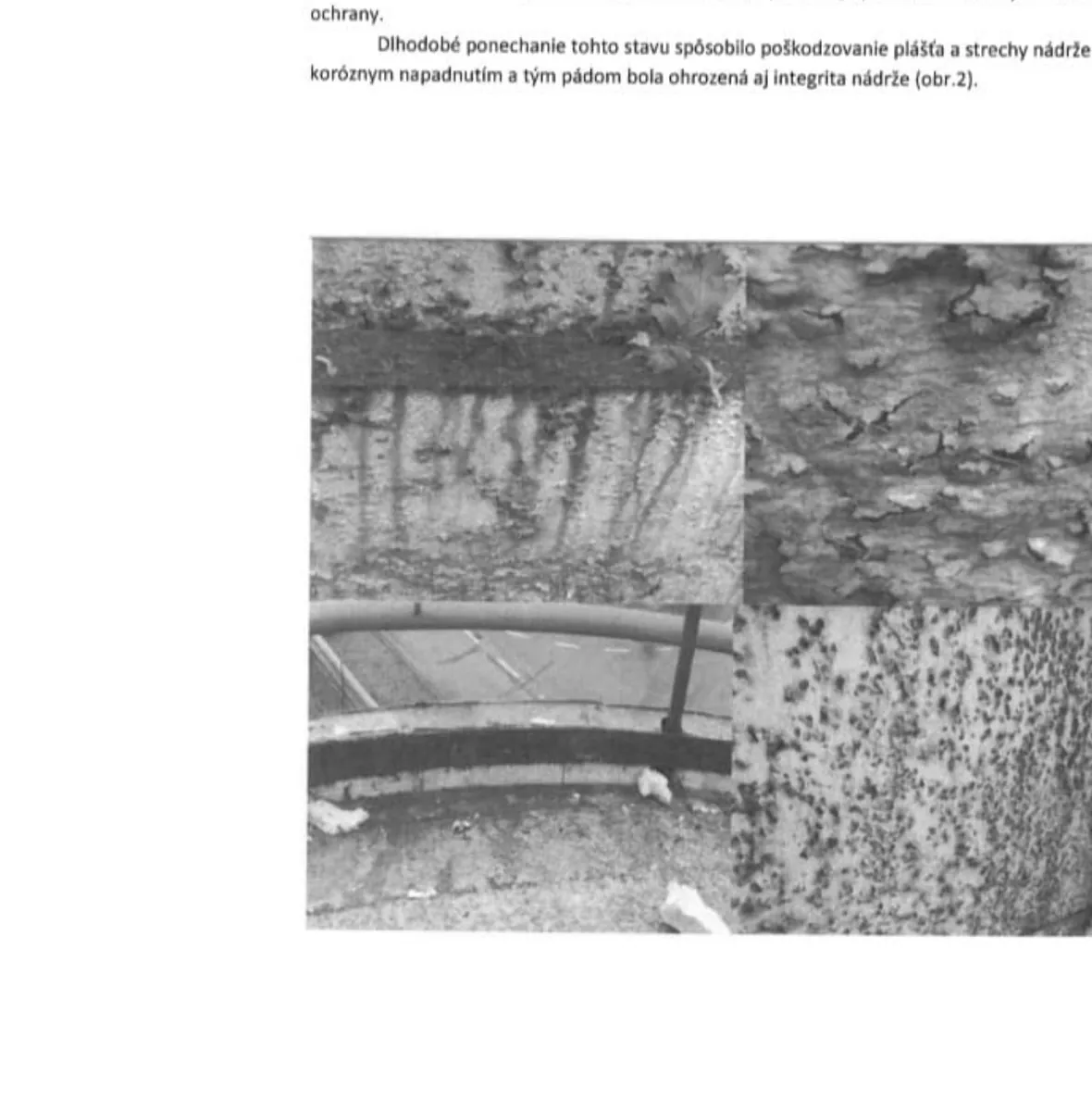
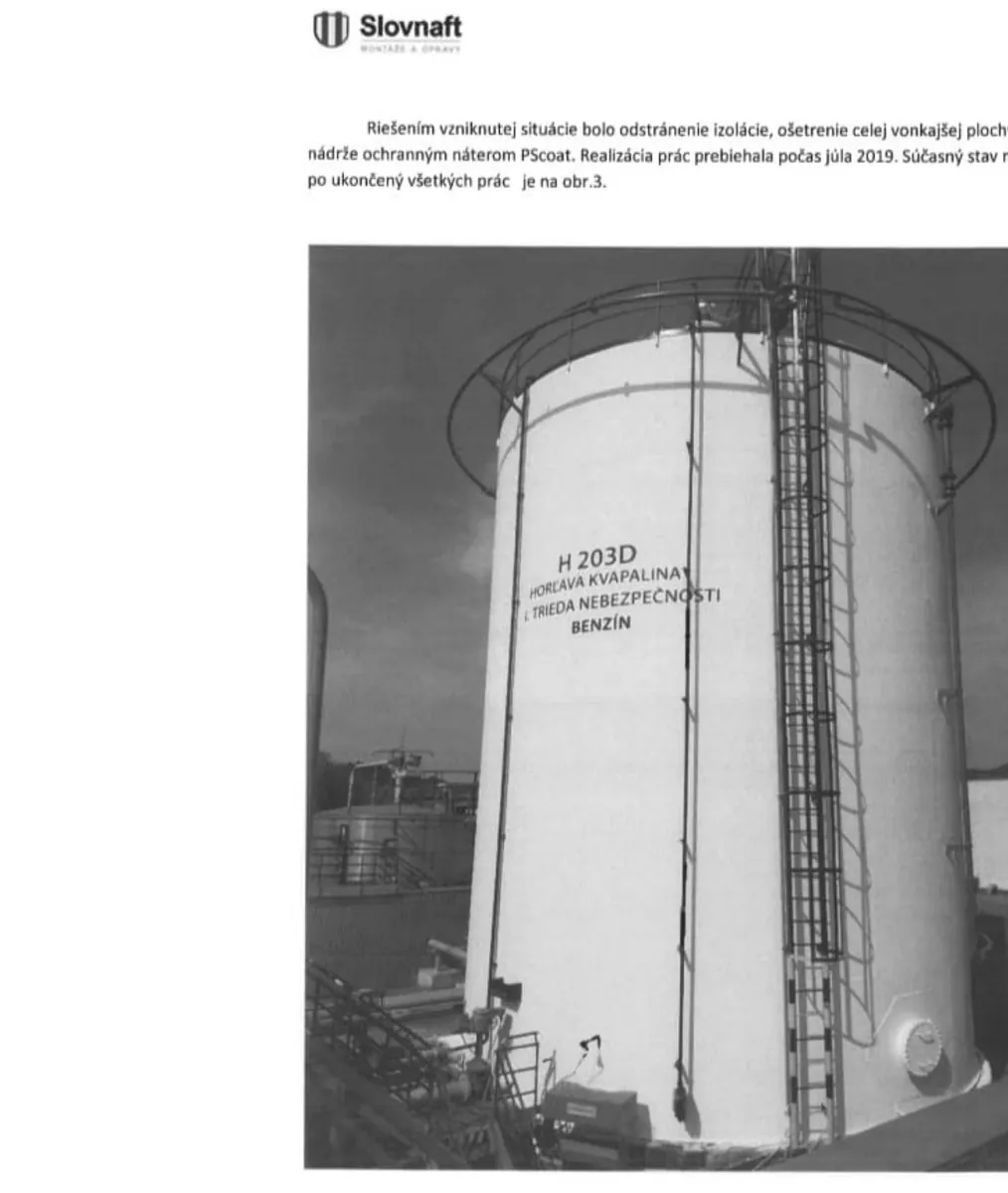
Technical report "Technická správa o izolácii benzínovej nádrže H203D technológiou PScoat" by Pavol Hanin (Technical Office PM-52, Terminál Kapušany): Tanks TKAP H203C and H203D serve as gasoline storage tanks and had subsequently been fitted with mineral wool insulation to limit seasonal temperature fluctuations of the stored product (and the resulting metering problems at the filling stations). Over time, this insulation became saturated with water and lost its original corrosion protection function; the resulting corrosion on the shell and roof of tank H203D endangered its integrity. The solution was to remove the insulation completely and instead treat the entire exterior surface of the tank with PScoat; the work was carried out in July 2019.
Corrosion damage on shell and roof before remediationTank H203D after completion of the PScoat coating (July 2019)
Temperature difference of stored product: PScoat tank (H203D) vs. tank still insulated (H203C)
ca. 2–3 °C
Result: The acute risk of corrosion from the water-saturated mineral wool insulation was resolved by replacing it with the PScoat exterior coating. The temperature of the stored gasoline continues to be monitored in both tanks; according to the report, a temperature difference of 2–3 °C between the tanks is already apparent, though a longer observation period is needed for reliable (objective) conclusions about the insulating effect.
This concerns a tank exterior surface with a comparatively low, near-ambient storage temperature. The primary purpose of the application was corrosion protection, not primarily thermal insulation.
IND · Stand August 2018 (laufendes Projekt, Phase 1)
Global rollout at Chevron Phillips: replacing aluminum cladding with PSCoat (pilot project Singapore)
Chevron Phillips Chemicals, vermittelt über Strebl Green Carbon Pte Ltd, Singapur · Installation:ALPHA Construction AG, Zug (Schweiz) (Lieferant)
Letter from Strebl Green Carbon (Diana Sherin Gomez, VP Sales) to Alpha Construction AG (Jean Kocian): Strebl Green Carbon is working with Chevron Phillips worldwide on introducing the PSC 250T thermal insulation coating, starting with the Singapore site. Chevron Phillips Chemicals USA has extensively tested the product and approved it for company-wide use; in Phase 1, the existing aluminum cladding in Singapore is being removed and gradually replaced with PSC 250T, with the goal of a worldwide rollout at all Chevron sites. Described test methodology: 180 days of outdoor weathering in direct sunlight, to check whether the coating absorbs moisture or changes in appearance/texture – the concern being that a failing coating would leave the underlying steel pipe surface vulnerable to corrosion under insulation (CUI), since according to the manufacturer no additional protective coating is needed under PSC 250T.
Result: According to the letter, the initial phases of the approval process at Chevron Phillips Chemicals USA were completed successfully; the full 180-day weathering test and its results are not included in the present document.
Unlike the other reference projects, this is a status/letter of intent regarding a multi-stage approval and rollout project that was ongoing at the time of writing – not a completed application case with measured insulation or corrosion protection results.
We use cookies and similar technologies to provide this website and, with your consent, to analyze it. Necessary cookies are required for the site to function. Privacy policy
Cookie settings
NecessaryAlways active
Technically required to operate the website, e.g. to store your cookie choice. Cannot be disabled.
Helps us understand how the website is used so we can improve it.